Legal Audio Consulting and Technical Report Review
Independent technical support for lawyers, legal teams and contested recordings
Legal audio consulting is used when a recording, prior expert report or disputed technical claim requires independent review, clarification or specialist technical support within a legal or investigative matter.
The service is distinct from a general forensic-audio overview and from the specialist examinations themselves. Its focus is the technical question presented to the legal team: what has already been examined, what can be checked, which conclusions are supported, which points require clarification and whether further specialist work is justified.
Work is carried out by Roberto Ruggeri, forensic audio specialist and can be managed remotely for international matters when the engagement permits it.
Written and reviewed by Roberto Ruggeri · Last modified: 23 September 2026
Independent Technical Support for Legal Teams

The consultation may begin before formal proceedings, during technical operations or after an expert report has already been issued. Typical work includes narrowing an overly broad technical question, reviewing the basis of an existing conclusion, preparing reasoned technical observations and identifying whether a separate specialist examination is required.
Terms such as legal audio expert, technical adviser, party-appointed expert and expert witness are used differently across jurisdictions. This page describes independent technical consulting and report review; it does not imply court appointment or any procedural authority that has not actually been conferred.
Questions of admissibility, evidential weight, legal responsibility and procedural strategy remain outside the technical opinion.
When Legal Audio Consulting Is Useful
- an existing forensic-audio report or expert opinion needs independent technical review;
- a disputed passage, timestamp, method or conclusion requires a focused technical response;
- a legal team needs to determine whether an audio issue is technically examinable before commissioning further work;
- technical operations are underway and reasoned observations or requests for clarification may be required;
- several competing technical explanations need to be distinguished without assuming the preferred theory is correct;
- a matter may require a separate authentication, voice-comparison, restoration or deepfake examination and the correct scope needs to be defined first.
The consultation is not designed to confirm a party’s position in advance. Its purpose is to identify what the available material supports, what it does not support and what remains unresolved.
What the Consulting Work May Include
Technical Question and Scope
The legal or investigative issue is translated into a technical question that can be answered, limited or rejected on the basis of the material actually available.
Critical Review of Existing Work
Prior reports, exhibits and technical analyses can be reviewed for methodological coherence, reproducibility, sample selection, alternative explanations, stated limitations and consistency between observations and conclusions.
Technical Observations and Adversarial Review
Reasoned observations, requests for clarification and identification of further checks may be prepared where the procedural context permits them.
Coordination of Specialist Examinations
If the question requires a separate technical examination, the consultation can identify the appropriate route without replacing the scope of Audio Authentication, Forensic Voice Comparison, Forensic Audio Restoration or Deepfake Audio Analysis.
Independent Review of an Existing Technical Report
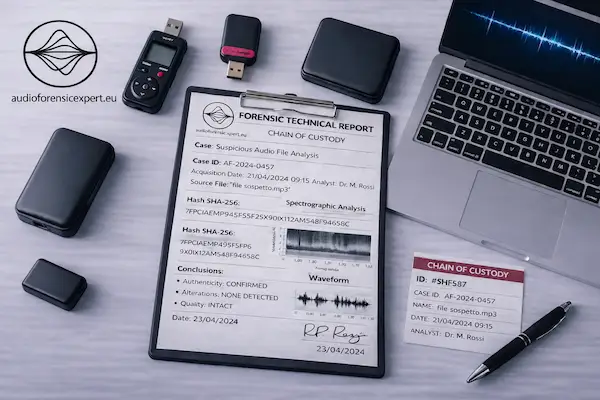
A critical review does not begin with the assumption that an error must be found. It asks whether the technical path can be understood, checked and supported by the material described in the report.
- Is the recording or file examined identified unambiguously?
- Are the relevant source, copy, export or derivative distinctions clear?
- Does the method address the actual technical question?
- Are software, versions, parameters, intervals and material decisions documented sufficiently?
- Are the selected samples or passages technically suitable for the conclusion drawn?
- Were alternative explanations and materially different conditions considered?
- Can another qualified examiner follow the reasoning from observations to interpretation?
- Are the stated limitations consistent with the strength of the conclusion?
The review may confirm the technical strength of prior work, identify points that require clarification or reveal material weaknesses. The result is not predetermined.
Adversarial Technical Review and Expert Support
During adversarial technical review, the adviser should identify points that materially affect the interpretation rather than treating every methodological difference as an error. Relevant observations should be expressed in a form that can be checked by the other participants.
- verify that the parties are discussing the same files or correctly identified copies;
- request clarification of procedures, parameters or decision criteria where necessary;
- identify missing checks or technically plausible alternative explanations;
- distinguish a difference in method from a contradiction in the underlying data;
- document points on which the available material does not permit a reliable answer.
The technical role remains independent of the legal outcome sought by the appointing party.
Possible Deliverables
- preliminary technical assessment or feasibility note;
- critical review of an existing expert report or prior analysis;
- reasoned technical observations or requests for clarification;
- technical memorandum identifying supported, unsupported and unresolved points;
- independent technical report where a fuller documented examination is required;
- supplementary observations following later technical developments, where agreed.
The deliverable is defined according to the purpose of the engagement. A preliminary assessment, report critique and full forensic examination are not interchangeable products.
Methodology and Role Boundaries
Preservation, working copies, traceability, validation, quality control and reporting are cross-cutting methodological matters and are therefore maintained on the dedicated Forensic Audio Methodology and Best Practice References page rather than repeated here.
The consultation does not determine admissibility, evidential weight or legal responsibility. It also does not convert an unsuitable or incomplete recording into evidence capable of supporting conclusions that the underlying material cannot sustain.
Where a specialist examination is required, its own methods and limitations remain those described on the relevant service page. For comparison of the available routes, use Forensic Audio Services.
Starting a Review for a Law Firm or Legal Team
An initial request does not need to reproduce the full history of the matter. The information most useful for deciding whether a technical review is appropriate is:
- the jurisdiction or procedural context and any relevant deadline;
- the specific report, recording, passage, timestamp or technical claim that is disputed;
- the principal files, reports or exhibits already available for review.
Detailed guidance on file versions, transfers and preparation belongs to the Contact and Audio Forensics FAQ pages.
Legal Audio Consulting FAQ
Can an existing expert report be reviewed without the original recordings?
Yes, but the conclusions are limited to what the report and accompanying documentation reveal. Review is stronger when the underlying files, exhibits and technical materials are also available.
Does legal audio consulting mean acting as a court-appointed expert or expert witness?
No. The procedural role depends on the jurisdiction and the specific appointment. Independent consulting does not by itself imply court appointment, expert-witness status or legal authority.
Can the consulting work be managed remotely?
Many tasks involving digital recordings, reports and technical documentation can be handled remotely. Physical attendance may still be required for particular acquisitions, hearings or technical operations.
Request a Preliminary Legal Audio Review
Describe the disputed technical issue, identify any existing report or recording that requires review and include the relevant deadline. The preliminary review is used to define whether legal audio consulting or a separate specialist examination is appropriate.