Deepfake Audio and Voice Cloning Analysis
Deepfake audio detection for synthetic speech, cloned voices and AI-generated vocal content
Deepfake audio analysis concerns the possible artificial origin of spoken content, including speech synthesis, voice cloning, voice conversion and other forms of AI-generated speech.
The examination is not based on whether a voice simply sounds unusual, and it does not rely on a single automated detector. It requires evaluation of file provenance, transformations, speech characteristics, alternative explanations and the applicability of the methods used to the specific material.
Examinations are carried out by Roberto Ruggeri, forensic audio specialist and can be managed remotely for international and cross-border matters outside Italy.
Preserved files · Documented provenance · Multiple methods · Proportionate conclusions
Last modified: 23 September 2026
What Deepfake Audio Means
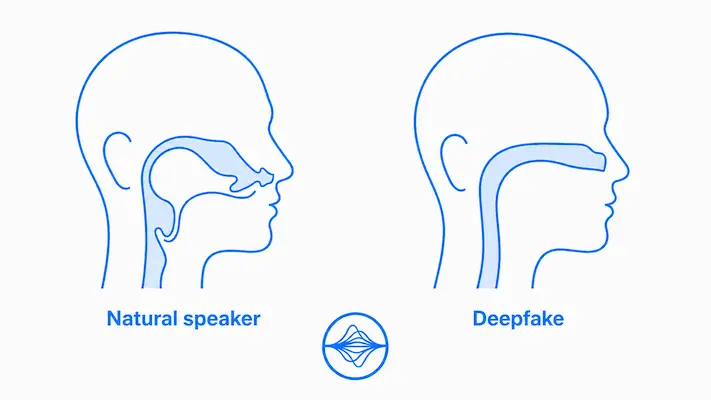
Deepfake audio refers to artificial or manipulated vocal content produced with techniques capable of generating realistic speech. The main categories include:
- speech synthesis: generating spoken language from text;
- voice cloning: synthesis designed to reproduce the perceived characteristics of a specific person;
- voice conversion: transforming a source voice so that it resembles a target voice;
- composition or replacement: inserting generated words or sections into an otherwise natural recording.
Human imitation is not, by itself, a deepfake. Likewise, replaying an audio recording through a loudspeaker does not demonstrate artificial generation, although replay or re-recording can obscure the technical history of the content.
When Deepfake Audio Detection May Be Useful
The examination may be appropriate when artificial speech is the primary technical question and the available material supports at least a preliminary assessment.
- suspicious voice messages received through messaging applications or online platforms;
- telephone calls, recordings or published content attributed to a person who disputes having produced the speech;
- audio used in attempted fraud, impersonation or deception;
- vocal passages that may have been synthetically generated and inserted into a longer recording;
- material for which automated detectors or previous assessments have produced conflicting results;
- recordings requiring technical review before legal, investigative or advisory use.
The mere impression that a voice sounds artificial is not sufficient. Read speech, whispering, heavy compression, processing or indirect recording can make natural speech sound unusual.
For a general overview of the available examinations, see the main forensic audio page.
What the Examination Can Establish
The assessment should be framed around competing hypotheses rather than a search for one universal indicator. Depending on the evidence, the material may be:
- more consistent with natural speech recorded under the stated conditions;
- more consistent with synthetic, converted or artificially composed speech;
- inconclusive because quality, duration, recording channel or subsequent transformations prevent a reliable assessment.
A conclusion should not turn an automated score into a verdict. It should explain which observations were made, which alternative explanations were considered, which methods were applied and which limitations remain.
A file can be technically continuous and still contain synthetic speech generated before export. Conversely, natural speech can be edited, re-encoded or inserted into another file. The origin of the speech and the integrity of the file are therefore separate technical questions.
Material, Provenance and Preservation
File provenance forms part of the examination. Audio downloaded from a platform, forwarded repeatedly, extracted from video or re-recorded from a loudspeaker may have lost or acquired technically relevant characteristics.
- the received version is preserved unchanged and identified by cryptographic hash where appropriate;
- analysis is performed on documented working copies;
- different versions of the same content are kept separate;
- conversions, extractions and processing steps are not confused with the reference file;
- stated date, source and recording device are treated as contextual information to assess, not as facts automatically proven by metadata.
If the content originates from a video, the original video container should also be preserved whenever possible.
How a Suspected AI-Generated Voice Is Examined
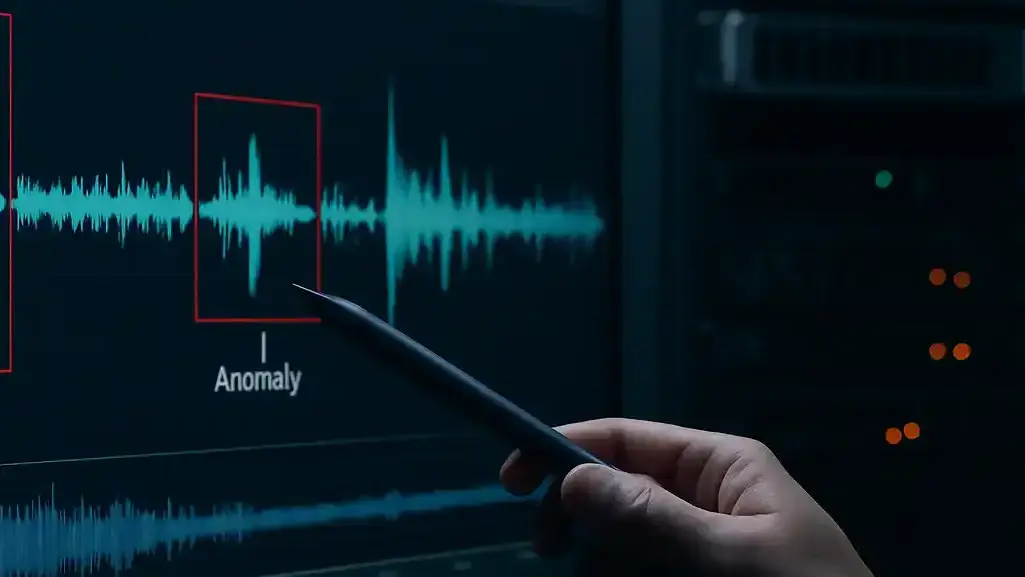
The sequence below is limited to deepfake-specific decisions. Cross-cutting principles for preservation, working copies, validation, quality control and reporting are maintained on the Forensic Audio Methodology page rather than repeated here in full.
1. Define the Technical Question and Competing Hypotheses
The first step is to determine whether the concern involves speech synthesis, voice cloning, voice conversion, artificial insertion, human imitation or another form of manipulation. Alternative hypotheses should be defined before results are interpreted.
2. Identify File Versions and Technical History
Available format, codec, recoverable metadata, re-encoding, forwarding, exporting and possible indirect recording are examined. Provenance analysis helps distinguish generation artifacts from artifacts introduced by the recording or transmission channel.
3. Critical Listening and Global Analysis
Speech is reviewed in its overall context, considering rhythm, pauses, breathing, intonation, pronunciation, transitions, background noise and consistency with other acoustic events. No perceptual impression is treated in isolation as proof.
4. Local Signal and Speech Analysis
Useful passages may be examined through waveform, spectrogram, spectrum, prosodic tracks and phonetic-acoustic observations. Any anomaly should be repeatable, documentable and evaluated against alternative explanations.
5. Comparative Checks and Controlled Reconstructions
Where reference files, earlier versions or platform information are available, comparative checks and controlled re-encoding or re-recording tests may be performed to assess whether apparent anomalies can be reproduced without invoking speech synthesis.
6. Automated Deepfake Detection Systems
One or more detectors may be used only when their applicability to the type of material is understood. Model version, threshold, analyzed duration, language, codec and input conditions should be documented. Conflicting or uncalibrated outputs should not be converted into a binary conclusion.
7. Interpretation and Reporting
Results are interpreted together while keeping observations, inferences and limitations distinct. The report describes the material, checks performed, methods, conditions of application and the actual scope of the conclusion.
Observable Features and Alternative Explanations
| Observed feature | Possible significance | Alternative explanations to exclude |
|---|---|---|
| Very regular or weakly variable prosody | May be compatible with synthesis or voice conversion | Read speech, acting, short utterance, dynamic processing |
| Unnatural transitions or onsets | May be compatible with generation, composition or post-production | Packet loss, ordinary editing, codec effects, noise gate |
| Metallic or oscillating artifacts | May occur with vocoders or generative systems | Aggressive denoising, telephone bandwidth, repeated compression |
| Inconsistent breaths, pauses or consonants | May reduce perceived naturalness | Microphone effects, phrase cuts, noise, whispering or individual speaking style |
| Background ambience inconsistent with the voice | May suggest overlay or composition | Noise reduction, movement, multiple microphones, indirect recording |
| Automated detector score | May provide model-specific evidence | Domain mismatch, language, codec, unseen attack, insufficient duration |
Audio artifacts must be interpreted in context. A feature that appears artificial can be produced by compression, filtering or transmission and is not, by itself, proof of a deepfake.
Why an Automated Detector Is Not Enough
Automated systems learn differences present in the data used to train and validate them. Performance can change when a file belongs to a language, codec, generator, recording channel or attack type that was not represented during development.
- a detector score is not a universal probability that a recording is fake;
- thresholds and evaluation metrics depend on the model and validation context;
- re-encoding, noise, reverberation and re-recording can alter detector behavior;
- a detector may fail on generators or attacks not represented during training;
- different detectors can produce conflicting outputs for the same sample;
- forensic use requires documentation, control of conditions and human interpretation.
The ASVspoof challenge series specifically evaluates spoofing countermeasures, synthetic speech, voice conversion, speech deepfakes, robustness and generalization. This illustrates why deepfake audio detection is a controlled evaluation problem rather than a one-click test.
Reconstructed Methodological Example
Illustrative assessment path for a suspicious voice message received through a messaging platform.
This is a reconstructed methodological example designed to illustrate a possible examination path. It does not reproduce a real engagement, report or case result, and it contains no client or case data.
The Concern
A compressed voice message was disputed because the voice appeared unusually uniform and some transitions seemed unnatural. A second version of the same content and a natural reference voice sample were also available.
Competing Hypotheses
- natural speech degraded by the platform and subsequent re-encoding;
- natural speech processed or composed through editing;
- synthetic or artificially converted speech;
- insufficient material to distinguish the alternatives reliably.
Technical Examination Path
The versions would be kept separate and compared for format, codec, duration, structure and re-encoding. The examination would include critical listening, waveform, spectrogram, prosodic and phonetic consistency, the relationship between voice and background ambience, documented multiple detectors and controlled re-encoding tests using the natural reference sample.
How the Outcome Should Be Expressed
If the apparent anomalies could be reproduced through compression and the detectors produced conflicting results, the technically appropriate conclusion would not be “authentic voice” or “certain deepfake,” but inconclusive material under the available conditions, with a request for a version closer to the source and additional contextual information.
If several complementary checks, each valid for the type of material, instead converged on features that could not reasonably be explained by channel effects, ordinary editing or re-recording, the report could state technical support for the artificial-generation hypothesis while still documenting conditions and limitations.
Reconstructed methodological example. It does not represent the outcome of a specific engagement and contains no client or case data.
What the Technical Report May Contain
- identification of the files and versions received;
- technical question, competing hypotheses and contextual information;
- stated provenance, format, codec, metadata and known transformations;
- methods applied and their relevant conditions of validity;
- analyzed sections, comparative checks and any controlled reconstruction tests;
- software, versions, models, thresholds and relevant parameters;
- convergent and conflicting results together with alternative explanations;
- technical conclusion, assumptions and limitations.
A forensic report should not be reduced to a “real/fake” label or a screenshot from an automated detector. It should make the examination path and the actual scope of the findings understandable.
Deepfake Audio, Authentication and Voice Comparison: Which Examination Is Needed?
These technical questions may overlap, but they are not equivalent:
- deepfake audio analysis: assesses possible synthetic, cloned or artificially converted vocal content;
- audio authentication: examines integrity, structure, re-encoding, possible cuts and splices;
- forensic voice comparison: compares a questioned voice with reference voice samples;
- forensic audio restoration: addresses noise and intelligibility where clarification is the primary issue.
The same matter may require more than one examination, but findings and limitations should remain separated. A voice compatible with a particular speaker is not necessarily natural, and a recording without obvious edits may still contain synthetic speech generated before export.
Material Useful for a Preliminary Assessment
- the suspicious file in the earliest available generation, preferably the version originally received or acquired;
- any earlier, later, forwarded or extracted versions;
- the original video container, where applicable;
- how the material was received, the platform involved and known transfer steps;
- natural reference voice samples if speaker attribution is also relevant;
- disputed timestamps and the specific technical question;
- any previous detector or analysis results, including the tool, model and date where known;
- whether a formal technical report is required and any relevant deadline.
Do not apply denoising, filters or conversions to the only available file before submission. A processed version may be useful as an additional working copy, but it should not replace the best available reference material.
Frequently Asked Questions About Deepfake Audio

Can it always be determined with absolute certainty whether a voice was generated by AI?
No. The strength of the conclusion depends on quality, duration, provenance, transformations and the applicability of the available methods. Some cases remain inconclusive.
Is an online deepfake detector sufficient?
No. A detector can provide an indication, but its threshold, model, training domain and the conditions of the file affect the result. Forensic use requires documentation and complementary checks.
Can WhatsApp or other messaging-app compression make deepfake analysis less reliable?
Yes. Compression, re-encoding and forwarding can remove or alter signal characteristics that may be useful for analysis. This does not automatically make the file unusable, but it can limit the available checks and the strength of the conclusion. Where possible, earlier or less processed versions should also be examined.
Is a natural reference sample from the person being imitated required?
Not always for the sole question of synthetic origin, but it can be useful where speaker compatibility also needs to be assessed or where comparative controls are required.
Can a cloned voice sound completely natural?
Yes. Modern systems can produce highly realistic speech, and some artifacts may be masked by compression, noise or re-recording. The absence of an obvious anomaly does not prove natural origin.
Does audio enhancement help detection?
Processing can make some features easier to perceive, but it can also alter or create artifacts. The untreated file should remain available and any enhancement should be documented.
Methodological References
For provenance, recording traces, post-production, competing hypotheses and reporting, the relevant ENFSI framework is the ENFSI Best Practice Manual for Digital Audio Authenticity Analysis, FSA-BPM-002, Issue 001. This is an audio-authenticity manual rather than a deepfake-specific detection standard.
For preservation, working copies and general forensic-audio documentation, see the SWGDE Best Practices for Forensic Audio.
For scientific evaluation of spoofing countermeasures, synthetic speech, voice conversion, speech deepfakes, robustness and generalization, see ASVspoof.

Request a Preliminary Deepfake Audio Review
Send the version closest to the source, explain how the recording was received and describe why the voice is considered suspicious. The preliminary review is used to assess feasibility, technical limitations and the appropriate examination path.