Forensic Audio Restoration
Controlled noise reduction and improvement of speech intelligibility
Forensic audio restoration is the controlled application of processing intended to reduce interference and make the signal of interest, particularly speech, more perceptible. The related term forensic audio enhancement is used here for technically controlled processing carried out with preservation, documentation and stated limitations.
The process does not create missing words, reconstruct material that was never recorded or guarantee that every phrase will become intelligible. Before treatment, the realistic technical margin for improvement is assessed, while the file received is preserved and processing is performed on a separate working copy.
The service is carried out by Roberto Ruggeri, forensic audio specialist and can be handled remotely for international and cross-border clients outside Italy.
Reference file preserved · Documented working copies · Progressive processing · Stated limitations
Last modified: 23 September 2026
When Forensic Audio Restoration May Be Useful
The service may be appropriate when a recording contains useful signal information but noise, distance, reverberation, interference or level imbalance makes listening difficult or speech hard to distinguish.
Files from smartphones, recorders, telephone calls, messaging applications, cameras, surveillance systems and other devices may be assessed. Provenance and known processing history matter because compression, forwarding and conversion can reduce the technical margin for improvement.
- conversations recorded at a distance or at a low level;
- voice messages affected by hiss, traffic, wind or mechanical noise;
- telephone calls and compressed audio with poorly defined speech;
- environmental recordings affected by hum, reverberation or changing interference;
- files in which different portions require different treatment.
For a general overview of the examination and the other available technical routes, see the audio forensic expert home page.
Treatable Interference and Main Limitations
Treatment is selected only after the type of disturbance and its relationship with the signal of interest have been assessed. The same technique is not suitable for every recording.
| Observed Problem | Possible Treatment | Main Limitation |
|---|---|---|
| Hiss or continuous noise | Spectral attenuation or adaptive noise reduction | If speech and noise occupy the same frequencies, excessive reduction can damage speech. |
| Hum and stable harmonics | Selective filters, notch filters or harmonic treatment | The affected frequencies may also contain useful speech components. |
| Rumble, wind or low-frequency noise | High-pass filtering, equalization or adaptive processing | Information already masked or distorted cannot be reconstructed. |
| Clicks, impulses or impacts | Impulse attenuation, interpolation or local treatment | An event overlapping speech may not be separable without loss. |
| Reverberation and echo | Dereverberation and reflection control | Reverberation is mixed with the signal and is not always reversible. |
| Weak speech or irregular levels | Gain, compression, leveling or automation | Increasing speech level also increases noise already present. |
| Overlapping voices, music or other sources | Source separation or selective spectral processing | Where sources share time and frequency content, separation may only be partial. |
| Digital clipping or signal loss | Artifact mitigation where possible | Missing or saturated samples cannot be recovered with certainty. |
Intelligibility, Listenability and Signal Quality

A file may sound more pleasant without becoming genuinely more intelligible, or some words may become easier to distinguish while residual noise remains. For this reason, the result is assessed by distinguishing three different objectives.
Intelligibility
How well speech can be understood. This is the main objective when the technical question concerns words or phrases that are difficult to distinguish.
Listenability
How comfortably the file can be reviewed with less fatigue or distraction. Listenability can improve even when the amount of understandable speech remains unchanged.
Signal Quality
How faithfully the file represents the recorded acoustic events. Overly aggressive processing may reduce noise while introducing distortion and reducing informational quality.
How Forensic Audio Restoration Is Performed
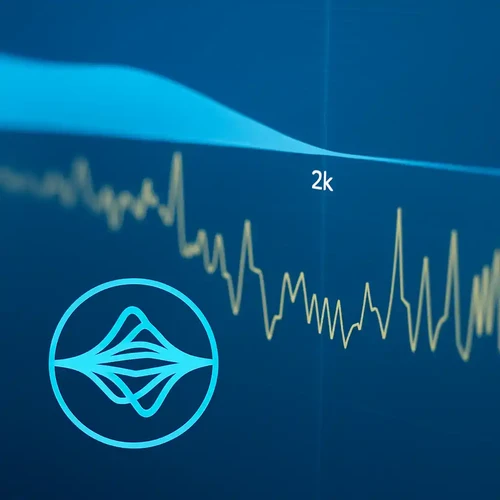
The sequence below is limited to restoration-specific decisions. Cross-cutting principles for preservation, working copies, validation, quality control and reporting are maintained on the Forensic Audio Methodology page rather than repeated here in full.
1. Define the Signal of Interest
The problem, relevant time regions and practical objective are clarified: understanding speech, reducing a disturbance, balancing levels or producing a version that is easier to review.
2. Preserve the Reference File and Create a Working Copy
The version received is kept unchanged and, where relevant, identified by a cryptographic hash. Processing is performed on a working copy or technically documented derivative without overwriting the reference file.
3. Technical Assessment
Critical listening, waveform, spectrogram, spectrum and, for multichannel files, channel relationships are used to describe the problems affecting the signal. Conditions may vary across the recording and require different treatment. For time-frequency interpretation, see how to read a spectrogram in forensic audio.
4. Treatment Planning
The processing order, regions to be treated and initial settings are selected without automatically applying the same chain to the whole file. Proprietary or AI-based algorithms are assessed on the specific material before use.
5. Progressive Processing
Processes are applied gradually, retaining intermediate versions where useful. If several applications are used, intermediate files are preferably preserved in an uncompressed format with parameters appropriate to the source.
6. Comparison and Residual Review
The processed version is compared with the untreated version. Where possible, the residual—the material attenuated by the process—is also reviewed to check that relevant speech components have not been removed.
7. Final Review and Documentation
The result is listened to again and checked for clipping, distortion, artifacts or information loss. In documented assignments, relevant software, versions, parameters, treated intervals and residual limitations are recorded.
How the Result Is Verified
A file is not considered improved merely because it contains less noise. Final review should determine whether the signal of interest is more intelligible or easier to review without a disproportionate loss of information.
- compare the starting version and the processed version at comparable listening levels;
- review waveform and spectrogram before and after treatment;
- listen to the residual to check what has been attenuated;
- check for metallic or tonal artifacts, clipping or unnatural changes;
- compare alternative versions where no single processing compromise is optimal;
- perform a final review after a listening break to reduce auditory fatigue.
If treatment produces no concrete benefit, or if the processing introduces changes greater than the advantage obtained, the treatment is reduced, modified or stopped.
Anonymized Real Case: Conservative Restoration of an Environmental Recording
Selective treatment of a long recording affected by environmental noise, highly variable levels, distant voices, footsteps and impulsive events.
Objective and Characteristics of the Material
The case concerned an environmental recording of approximately one hour and thirty minutes, characterized by background noise, vehicles, distant voices, footsteps, percussive sounds and large level variations between different parts of the recording.
The objective was to increase audibility and make review more manageable without removing or damaging potentially useful acoustic components, including voices, footsteps, impulsive events and other signals potentially associated with the presence or movement of people.
Treatment Strategy
- initial increase of overall level to improve general audibility;
- additional level adjustments applied only to portions that required them;
- cautious attenuation of background noise without indiscriminately reducing useful components;
- retention of high-intensity impulsive events where attenuation could have removed nearby acoustic information;
- selective attenuation only in portions that were particularly disruptive to listening.
Treatment was therefore differentiated over time. A single aggressive processing chain was not applied to the entire recording because level, content and the relationship between useful signal and noise changed substantially across the file.
Descriptive Timeline of Main Events
During listening, the most perceptible events were noted. The table below gives an anonymized and non-exhaustive selection from the technical timeline.
| Time Reference | Described Acoustic Content |
|---|---|
| 00:00–13:41 | Environmental noise, vehicles, distant voices and other background sounds |
| 19:43 | Impulsive event, footsteps and additional percussive sounds |
| 29:07 | Voice signal more perceptible than earlier voices, with footsteps present |
| 30:59 | Voice signal and percussive events |
| 38:49 | Voice and percussive signals perceived as more prominent or direct in the recording; source distance was not established |
| 47:03–end | Content compatible with multimedia playback |
Result, Listening Conditions and Limitations
The delivery included a processed version aimed at improved audibility and a technical note describing the main perceived events. Observations were expressed cautiously where the nature or distance of a source could not be established with certainty.
The processing was not presented as complete recovery of speech or complete source separation. Some transient events and large level differences were intentionally retained to avoid compromising potentially relevant information.
For review, suitable closed-back headphones at a moderate listening level were recommended. Listening through computer or smartphone loudspeakers was discouraged because of their limited reproduction of weak components and the presence of potentially uncomfortable impulsive events.
Anonymized real case. This summary is limited to the audio-improvement work and the description of principal events. Names, file provenance and unnecessary details are omitted. The available technical note does not report hashes, software, versions or numerical processing parameters; those elements are therefore not attributed to this case on this page.
What May Be Delivered
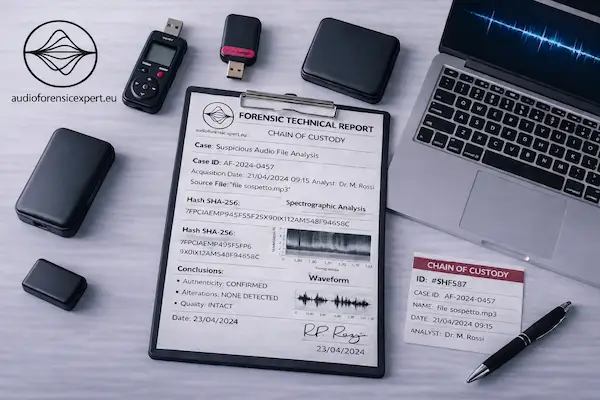
The content of the delivery is defined before work begins and depends on the agreed assignment. It may include:
- one or more processed versions of the file;
- files in an uncompressed format or another agreed format;
- identification of the treated portions and the objectives pursued;
- a concise or detailed description of the applied processes;
- alternative versions where different processing compromises are useful;
- a technical report, images or supporting material where agreed;
- explicit description of the limitations remaining after treatment.
The exact scope, turnaround and deliverables are agreed before processing begins.
Technical Limits of Forensic Audio Restoration

- A word that was not recorded or is completely masked cannot be recreated in a forensically reliable way.
- Lossy compression can remove information that no filter can restore.
- Reverberation, microphone distance and overlapping voices can severely limit separation.
- Clipping, drop-outs and saturation may involve irreversible sample loss.
- AI-based tools may introduce components that were not present or plausible-sounding artifacts that are not reliable evidence.
- A more pleasant-sounding result does not demonstrate that a specific verbal interpretation is correct.
For these reasons, unlimited recovery is not promised. The result is described in relation to the file received, the processing applied and the information actually preserved in the signal.
Forensic Use and Excluded Purposes
In forensic work, the processed file is a technical derivative and does not replace the recording as received. The reference version should remain preserved and the result should remain traceable to the processing applied.
Audio restoration does not establish whether a file is authentic, does not automatically identify a speaker and does not replace transcription or legal assessment. Where the technical question is different, the following services may be relevant:
If a processed file is also intended for later voice comparison, the versions and processing steps should remain distinct. Processing should not automatically be treated as neutral with respect to speaker characteristics.
The service may also be requested for non-judicial purposes such as interviews, meetings, documentaries or archives, but the same technical possibilities and limitations apply.
Material Useful for a Preliminary Assessment
To estimate the realistic margin for intervention, it is useful to provide:
- the original version or earliest available generation;
- any forwarded, exported or already processed copies;
- recording device, application and acquisition method, if known;
- file duration and the time intervals to be examined;
- the signal of interest: voice, phrase, noise or another component;
- any treatment already applied and the formats of the available versions;
- whether a technical report is required and any relevant deadline.
It is preferable not to convert the file again before submission. If the audio comes from a video, preserving the original container can be useful; see audio extracted from video.
Where the problem may depend on distortion, codecs or conversion, the guide on audio artifacts may also be relevant.
Frequently Asked Questions About Forensic Audio Restoration

Can background noise always be removed completely?
Not always. Noise that is sufficiently distinct from speech may be attenuated effectively. Where it occupies the same frequencies or changes rapidly, aggressive removal can damage speech.
Can words that cannot be heard be recovered?
Only where sufficient information remains in the signal. A word that is absent, completely masked or removed by compression cannot be reconstructed reliably.
Can WhatsApp or other app compression limit restoration?
Yes. Compression and re-encoding can remove detail or introduce artifacts that reduce the margin for improvement. The file can still be assessed to determine what processing is technically useful without attributing missing information to the treatment.
Does processing modify the evidentiary recording?
The reference file is not overwritten. The processed result is a separate, documented derivative that should be retained together with the version received.
How is the result checked after restoration?
The processed version is compared with the reference file, assessing intelligibility, introduced artifacts and possible over-processing. The file received remains separate and unchanged.
Is the same processing applied to the entire recording?
Not necessarily. Noise, distance and intelligibility may change over time; different regions can require different processes or settings.
Further practical questions are available in the Audio Forensics FAQ.
Specific Methodological Reference
The workflow described on this page is aligned with the SWGDE Best Practices for Enhancement of Digital Audio, document 20-A-001-2.0, together with the broader preservation, traceability and documentation principles described in this site’s methodology. A dedicated ENFSI best-practice manual specifically for digital-audio enhancement was not identified in the current ENFSI audio/speech best-practice materials reviewed for this page.
Request a Preliminary Review of the File
Send the version closest to the original, identify the passages to be reviewed and describe which component needs to become more distinguishable. The preliminary assessment helps clarify technical feasibility, limitations and the appropriate scope of the work.