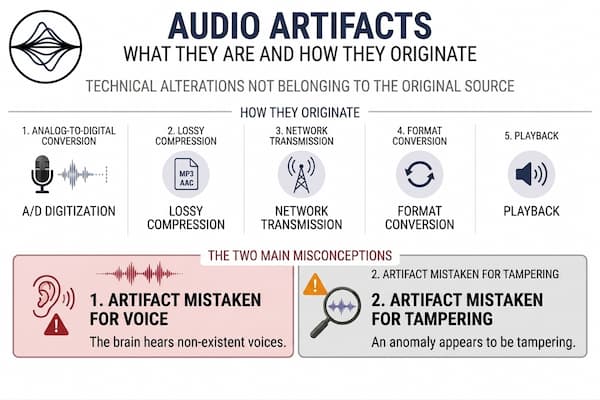
An audio artifact is a feature introduced or materially shaped by the recording, conversion, coding, transmission, processing or playback chain rather than by the acoustic event being examined. In forensic audio, that distinction matters because a click, tonal component, distortion, short gap or smeared transient can be misinterpreted if its technical origin is not considered.
Not every unwanted sound is an artifact. Background noise, reverberation, wind, microphone handling and an actual impact can be genuine parts of the recorded acoustic scene. Conversely, some artifacts are normal consequences of a device, codec or transmission system and do not imply that a recording was edited or manipulated.
This guide focuses on the meaning, technical causes and forensic interpretation of audio artifacts. Questions about reconstructing re-encoding history belong to codec lineage; questions about cuts, splices or integrity belong to audio authentication.
Written and reviewed by Roberto Ruggeri, forensic audio specialist. Last modified: 23 September 2026
What Is an Audio Artifact in a Forensic Recording?
The term artifact is used broadly for an unwanted defect, distortion or trace produced by a technical process. In a forensic examination, the label should not replace the observation itself. It is more informative to describe what is actually present—for example, clipped peaks, a repeated short segment, a narrow-band tone or a transient surrounded by coding noise—and then assess which mechanisms are technically compatible with it.
An artifact may already be encoded in the submitted file, or it may arise only during decoding, resampling, playback or monitoring. This distinction can be important. If a suspected phenomenon changes or disappears when the same file is decoded and reproduced through a different controlled path, the feature may not be part of the stored audio signal itself.
The presence of an artifact therefore answers a narrower question than “is the recording authentic?” It identifies or supports a technical effect that may have influenced the signal. Its evidential significance depends on where in the signal chain the effect could have arisen and whether alternative explanations remain plausible.
Where Audio Artifacts Can Enter the Signal Chain
| Stage | Examples | Possible effect in the recording | What it does not establish by itself |
|---|---|---|---|
| Acquisition and analog front end | Overload, limiting, automatic level control, electrical interference | Distortion, pumping, level changes, repetitive impulses | That the file was edited later |
| Analog-to-digital conversion | Clipping, aliasing, quantization-related effects | Flattened peaks, folded spectral components, low-level distortion or noise | The exact device or acquisition history |
| Lossy coding | MP3, AAC or other perceptual coding | Bandwidth limitation, pre-echo, temporal smearing, coding noise or warbling | The exact encoder, number of encoding generations or manipulation of content |
| Network transmission | Packet loss, packet-loss concealment, jitter-buffer behavior | Drop-outs, repeated or interpolated material, abrupt transitions or altered background texture | That a discontinuity is a deliberate cut |
| Processing | Noise reduction, source separation, de-clipping, dynamics processing | Pumping, residual tonal noise, transient alteration or loss of signal detail | That the same feature existed in the unprocessed recording |
| Playback and rendering | Decoder, resampler, audio driver or monitoring chain | Playback-specific distortion or discontinuity | That the effect is stored in the evidentiary file |
The same audible symptom can have more than one technical cause. A short click, for example, may be an acoustic impact, electrical interference, a digital impulse, a transmission problem or a processing side effect. Classification therefore depends on context and comparison, not on appearance alone.
Acquisition and Conversion Artifacts
Clipping and overload
Clipping occurs when a signal exceeds the level that a recording or processing stage can represent. In a waveform, severe clipping may appear as truncated or flattened peaks; acoustically, it can introduce additional distortion components. The underlying cause can occur at different stages, including the microphone preamplifier, analog electronics, analog-to-digital conversion or later processing.
A flat-looking peak is not sufficient to identify the exact stage. Limiting, saturation and some naturally bounded signals can produce superficially similar shapes. A forensic description should therefore distinguish the observation from the proposed mechanism and avoid treating clipping as evidence of editing.
Aliasing
Aliasing can occur when frequency content above the effective Nyquist limit is not adequately removed before sampling, or when conversion or resampling is performed inadequately. Energy can then appear at frequencies that do not represent the original spectral location of the source component.
Aliasing should not be assumed merely because a file has been resampled. Well-designed conversion includes anti-alias filtering, and the presence, strength and pattern of any alias components depend on the system and signal involved.
Quantization-related effects
Digital amplitude values are represented with finite numerical resolution. Quantization error can contribute noise or distortion, particularly when signals are represented at low resolution or processed at very low levels without appropriate treatment. Dither may be used to decorrelate quantization error from the signal.
In ordinary modern 16-bit or 24-bit recording conditions, quantization effects may be far less important than microphone self-noise, environmental noise, analog electronics or lossy coding. They should not be invoked as a default explanation without evidence that the recording conditions make them relevant.
Lossy Compression Artifacts: What They Can Indicate
Perceptual audio codecs reduce data by exploiting signal redundancy and characteristics of human hearing. Depending on the codec, encoder, bitrate, signal and operating mode, the resulting artifacts can include pre-echo around transients, temporal smearing, bandwidth limitation, granular or warbling textures and coding noise. The strength of these effects is not fixed: an artifact that is obvious in one passage may be weak or absent in another passage of the same encoded file.
Compression artifacts can be forensically relevant because they may explain apparent anomalies that would otherwise be attributed to the acoustic source or to editing. They can also limit later enhancement and obscure weak speech or transient detail.
However, a compression artifact by itself does not reconstruct the file’s complete technical history. Determining whether a file was rewrapped, transcoded, resampled or encoded more than once is a separate question that may require container, bitstream and signal-level evidence. That topic is covered in Codec Lineage in Forensic Audio: Re-Encoding and File History.
Packet Loss, Concealment and Transmission Artifacts
Networked audio can be affected by delay variation, packet loss and the mechanisms used to conceal missing data. Packet-loss concealment may repeat, extrapolate, interpolate or otherwise synthesize replacement material according to the codec and decoder implementation. Jitter buffers can also affect continuity when their timing is adjusted.
The audible or measurable result may include a short drop-out, an abrupt change in background texture, repeated or held material, attenuation, a synthetic-sounding continuation or another local discontinuity. There is no single universal “packet-loss signature”: the manifestation depends on the codec, loss pattern, concealment algorithm and surrounding signal.
A further distinction is whether the transmission effect became part of a stored decoded recording or occurred only during real-time playback. Examination of the actual submitted file, and comparison with other available versions where they exist, is therefore more informative than attributing a brief anomaly to “network loss” from listening alone.
Processing and Enhancement Artifacts
Processing can improve audibility while also altering parts of the signal. Strong noise reduction, source separation, de-reverberation, de-clipping, dynamics processing and other operations may introduce side effects such as pumping, tonal or “musical” residuals, smearing, transient modification, changes in background texture or loss of weak components.
The effect depends on the algorithm, settings and source material. Proprietary or unpublished processing should not be assumed to behave neutrally. Current SWGDE guidance for forensic enhancement specifically recommends testing such tools, comparing processed output with input and avoiding over-processing or additional distortions.
For this reason, an artifact observed only in an enhanced derivative should not automatically be attributed to the recording as received. The detailed question of how to improve intelligibility while controlling processing side effects belongs to Forensic Audio Restoration.
Artifact or Source Event? Distinguishing the Technical Origin
| Observed feature | Technical explanation to consider | Alternative explanation to test | Cautious forensic wording |
|---|---|---|---|
| Brief broadband click or impulse | Electrical or digital impulse, transmission or processing artifact | Physical impact, switch, handling event or other real acoustic source | “A short impulsive event is present; its source is not established by morphology alone.” |
| Short gap or abrupt attenuation | Drop-out, packet loss, gate, buffer or processing effect | A true pause or abrupt change in the acoustic scene | “The discontinuity is compatible with more than one mechanism and requires contextual examination.” |
| Narrow tonal or repetitive component | Electrical interference, device process or coding/processing residue | Actual tonal environmental source | “The component is observed; attribution requires comparison with system and environmental explanations.” |
| Repeated or held short material | Packet-loss concealment or buffer-related repetition | A genuinely repeated source event | “Repetition is present, but the generating mechanism is unresolved from this feature alone.” |
| Smeared transient | Lossy coding or other processing | Reverberation, overlapping acoustic energy or analysis-display effects | “Temporal spreading is observed; coding is one compatible explanation, not a unique conclusion.” |
Graphical displays can help locate and describe these features, but display settings can also affect how a transient or spectral component appears. For the separate question of time-frequency representation and display parameters, see How to Read a Spectrogram in Forensic Audio.
Artifact or Possible Edit?
An artifact and an edit are not synonymous. Acquisition, encoding, transmission and processing systems can produce discontinuities or distortions during ordinary operation. Conversely, some post-production operations may leave traces that need to be evaluated together with file structure, signal continuity, known provenance and alternative hypotheses.
ENFSI guidance on digital audio authenticity treats traces from recording and encoding separately from possible post-processing traces and frames interpretation through competing hypotheses rather than a binary reaction to a single anomaly. If the technical question is whether a recording contains cuts, splices, insertions or other post-recording modification, the appropriate destination is Audio Authentication.
What Audio Artifacts Can and Cannot Establish
When correctly interpreted, artifacts can help:
- identify technical limitations that affect the evidential value of a passage;
- explain why a signal differs from the underlying acoustic event;
- distinguish plausible system, coding, transmission or processing effects from source events;
- identify regions that require comparison with other versions, reference recordings or controlled tests;
- determine whether a separate authentication, codec-history or restoration question should be examined.
By themselves, artifacts generally cannot:
- prove that a recording was deliberately manipulated;
- identify who performed an operation or why it was performed;
- reconstruct the complete codec or file lineage;
- identify a specific device, encoder or software package without additional supporting evidence;
- recover acoustic information that was never captured or was irreversibly discarded;
- establish that an ambiguous sound is a particular word or voice.
That last distinction is particularly important in weak or ambiguous recordings. The cognitive interpretation of speech-like patterns is addressed separately in Auditory Pareidolia in Audio Forensics.
Forensic Interpretation: Keep the Observation Separate from the Explanation
A defensible interpretation begins with the observable feature and only then considers its cause. Terms such as clipping, packet loss, codec artifact or processing residue should be used as conclusions only when the data support that mechanism.
Useful checks may include whether the feature is present in more than one available version, whether it is reproducible with the same decoding path, whether the surrounding signal behaves consistently with the proposed mechanism and whether a controlled reference can reproduce comparable behavior. If the evidence supports more than one mechanism, the conclusion should remain correspondingly limited.
This is narrower than a complete forensic workflow. Preservation, working copies, traceability, quality control and reporting are covered on the dedicated Forensic Audio Methodology and Best Practice References page.
Related Forensic Audio Questions
- Re-encoding and technical file history: Codec Lineage in Forensic Audio.
- Cuts, splices, integrity and possible post-recording modification: Audio Authentication.
- Time-frequency display and spectrogram interpretation: How to Read a Spectrogram in Forensic Audio.
- Speech-like perception in ambiguous sound: Auditory Pareidolia in Audio Forensics.
- Controlled enhancement and intelligibility: Forensic Audio Restoration.
- Preservation, working copies and reporting principles: Forensic Audio Methodology.
Technical and Forensic References
- Federal Agencies Digitization Guidelines Initiative (FADGI) — Artifact (defect). General technical definition of artifacts as undesirable defects or distortions introduced in digital reproduction.
- SWGDE — Best Practices for Forensic Audio, 08-A-001-2.5. General forensic-audio handling and examination guidance.
- SWGDE — Best Practices for Enhancement of Digital Audio, 20-A-001-2.0. Current guidance on enhancement, distortions, testing of processing and control of additional artifacts.
- ENFSI — Best Practice Manual for Digital Audio Authenticity Analysis, FSA-BPM-002. Recording/encoding traces, possible post-processing traces and hypothesis-based interpretation.
- ITU-T Recommendation G.161. Interaction of speech-processing systems, including codec, packet-loss concealment, packet loss, jitter and jitter-buffer effects.
- ITU-T Recommendation G.1020. Packet-network impairments, delay variation, packet loss, de-jitter buffers and packet-loss concealment.
- IETF RFC 6716 — Definition of the Opus Audio Codec. Technical specification for Opus and its packet-loss-related operating behavior.
- Painter, T. & Spanias, A. (2000) — Perceptual Coding of Digital Audio, Proceedings of the IEEE, 88(4), 451–515.
- Liu, C.-M., Hsu, H.-W. & Lee, W.-C. (2008) — Compression Artifacts in Perceptual Audio Coding, IEEE Transactions on Audio, Speech, and Language Processing, 16(4), 681–695.
Reference to external standards and professional guidance does not imply certification, accreditation, membership or endorsement. Documents can be revised; the current official version should be checked when used in casework.
If an artifact may affect the interpretation of case material, the recording can be reviewed as part of a defined forensic audio question.