Audio Authentication
Technical forensic examination of integrity, consistency and possible post-recording modification
Audio authentication is a technical forensic examination used to assess whether the characteristics of a file and the traces present in the signal are consistent with the stated provenance and recording process, or whether inconsistencies, discontinuities or indicators of post-processing require further examination.
The outcome does not come from a single program or graph. Findings are considered together, distinguishing what is observed, technically plausible explanations and the limitations imposed by the quality and history of the material.
Examination by Roberto Ruggeri, forensic audio specialist· Remote international and cross-border casework available outside Italy
For a broader overview of available examinations, see the audio forensic expert home page · Last modified: 23 September 2026
File Integrity and Technical Authenticity
File integrity and technical authenticity are not the same thing. A cryptographic hash can identify a file and verify that it has not changed since the hash was calculated; by itself, it does not show how the recording was produced or whether the content had already been modified before that point.
Authenticity analysis instead considers traces left by the recording process, encoding, device, acoustic environment and any subsequent operations. The aim is to determine whether these elements are internally consistent and compatible with the available provenance information, or whether unexplained anomalies are present.
The examination is technical. It does not by itself determine the lawfulness of a recording, admissibility in a particular jurisdiction, overall evidential weight or the intention behind any modification. If the question is whether a questioned voice is compatible with a particular speaker, rather than whether the file itself has been altered, see Forensic Voice Comparison.
When Audio Authentication May Be Appropriate
Suspected Cuts, Splices or Other Modifications
The examination is relevant where there are concerns about interruptions, deletions, insertions, assemblies, digitally applied level changes, resampling, repeated encoding or other post-recording operations.
A perceived or visual change is treated as a point to investigate, not as automatic proof of editing. Natural acoustic events, handling, environmental changes, automatic device functions and compression artifacts can produce transitions that require alternative explanations.
Files from Smartphones, Apps, Cloud Services or Forwarding
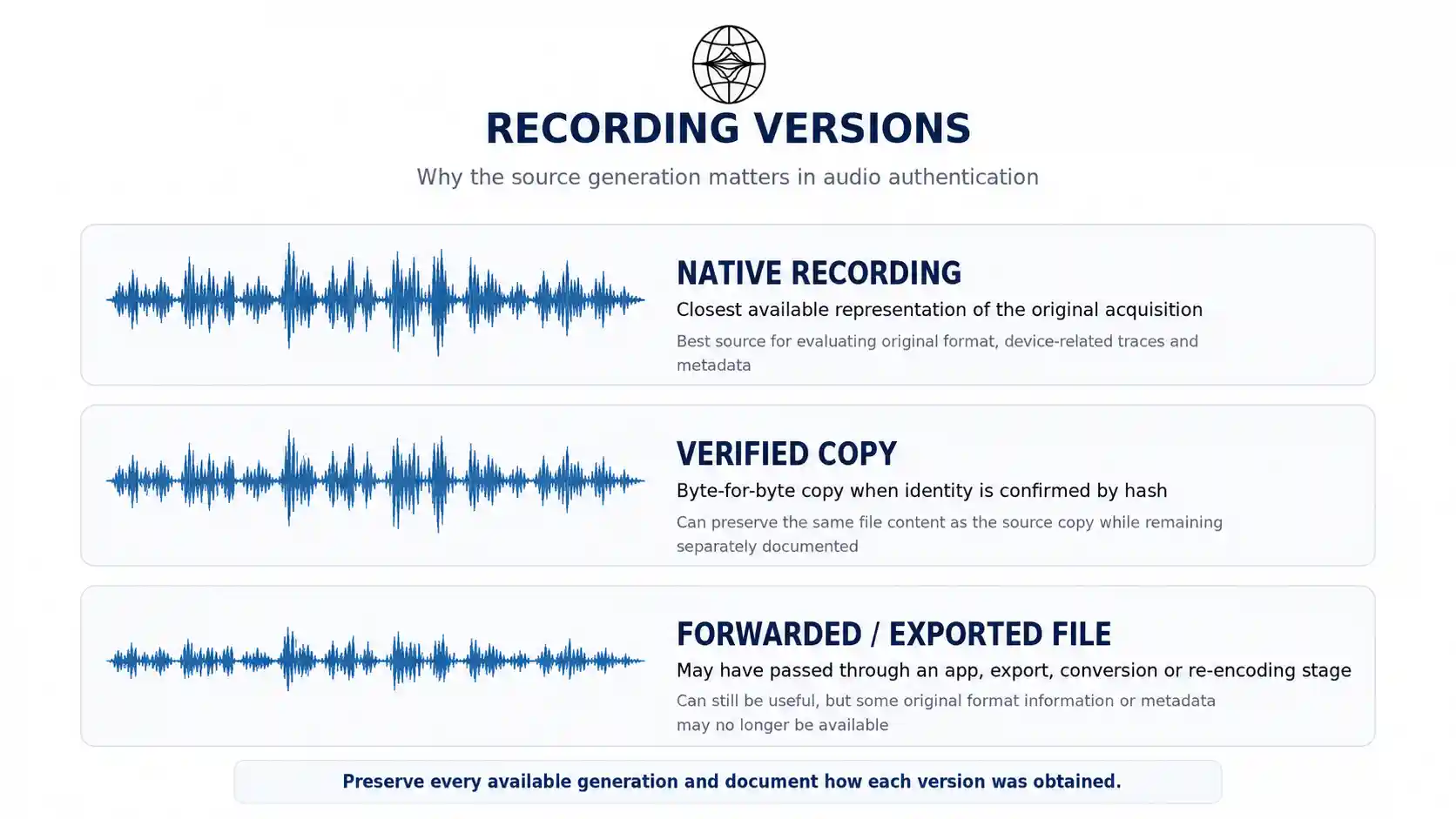
WhatsApp, Telegram, email, cloud services, smartphone exports and transfers between devices can change the container, codec, metadata and signal quality. A copy or forwarded file may still contain useful information, but it may not allow direct examination of the original file format.
Where possible, the transfer history should therefore be reconstructed and the native recording, earliest available generation and later versions kept distinct.
Consistency with the Stated Device, Software and Recording Conditions
Where information about the device, application, settings, acoustic environment or known interruptions is available, those data may be compared with the file structure and traces observed in the signal. If the recording device is available, exemplar recordings made under documented and comparable conditions can sometimes be useful.
If the primary concern is artificial, synthetic or cloned speech, see Deepfake Audio Analysis. That is a distinct technical question from general file authentication.
What Can Be Examined
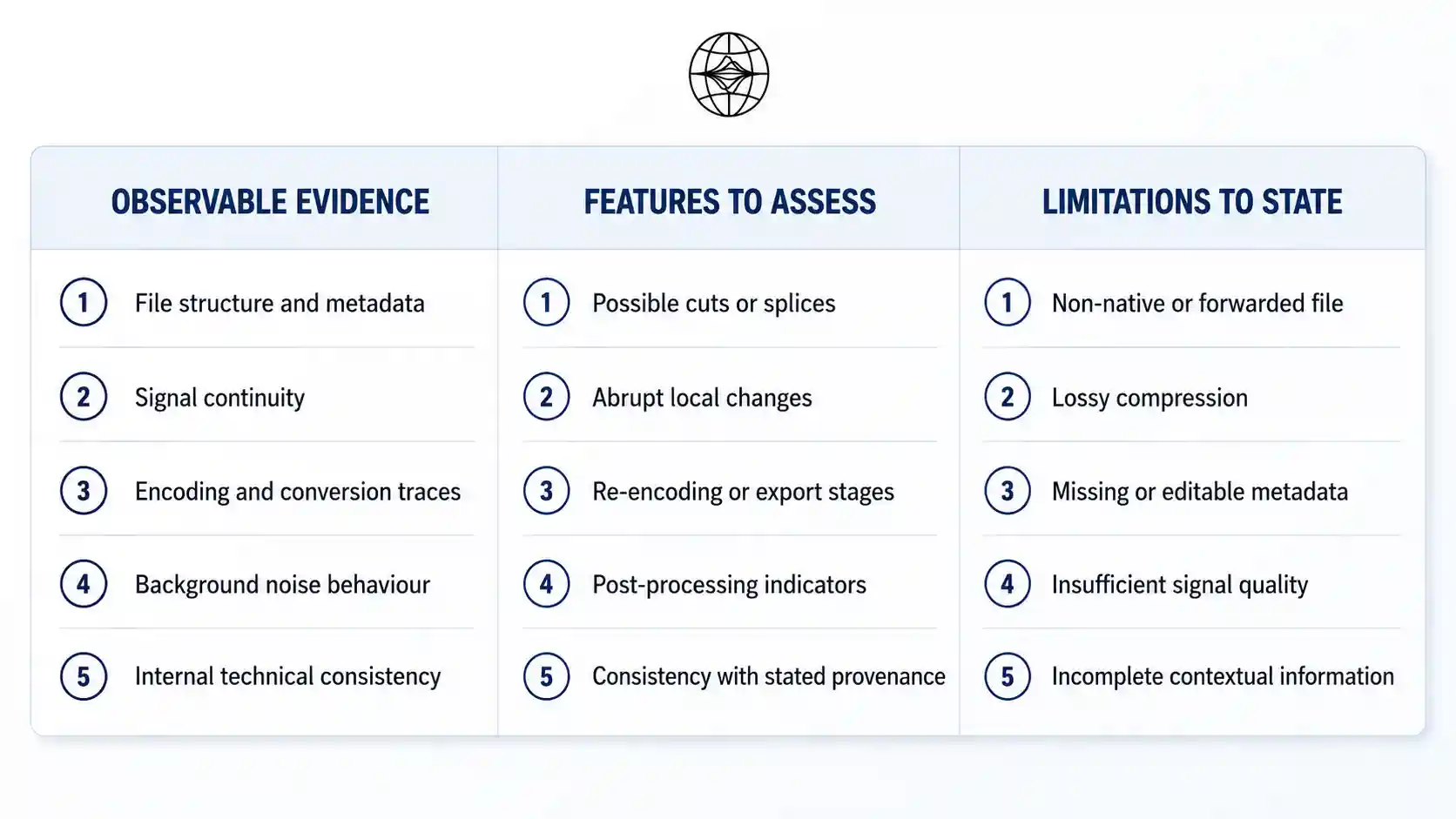
File Structure, Format and Metadata
The examination may include the container, codec, number of streams, duration, sample rate, bit depth, bitrate, chunks or atoms, descriptive fields and other accessible metadata. Findings can be cross-checked between tools where useful.
Missing, generic or editable metadata do not by themselves prove authenticity or manipulation. Filesystem timestamps, filenames and application dates must be interpreted in relation to the documented provenance and history of the material.
Encoding, Conversion and Re-encoding
Encoding can leave traces relating to format, bitrate, mono or stereo handling, bandwidth filtering and re-encoding stages. The purpose is to distinguish features consistent with the stated handling of the file from elements that are unexplained or technically inconsistent.
Signal Continuity and Recording Traces
Critical listening, waveform and spectrogram review may be used to examine continuity of speech, ambient noise, reverberation, transients, energy, offsets, periodic components and other relevant traces. Variations are considered together with acoustic events and available contextual information.
Internal Consistency and Contextual Comparison
Observed traces are checked for inconsistencies within the recording and, where possible, against the device, software, settings, known events or exemplar recordings. The applicable checks always depend on the material actually available.
How Forensic Audio Authentication Is Conducted
There is no universal test sequence that should be applied indiscriminately. The service-specific sequence below summarizes the authentication path. Cross-cutting principles for preservation, working copies, validation, quality control and reporting are maintained on the Forensic Audio Methodology page rather than repeated here in full.
1. Define the Technical Question and Hypotheses
The stated provenance, production process, available versions and specific concerns are clarified. The question is translated into technically testable hypotheses rather than beginning from a preferred conclusion.
2. Receipt, Identification and Working Copy
The native recording or earliest available generation is requested where possible. The file received is identified by hash and preserved unchanged; technical operations are performed on a verified working copy. Necessary conversions are documented and should preserve information relevant to the examination.
3. Global File Examination
Global checks address the file as a whole and may include structure, format, metadata, encoding, duration, general statistics and the behavior of recording traces over time.
4. Local Examination of Points of Interest
Disputed passages or identified anomalies are examined locally using listening, waveform, spectrogram, energy measurements or other relevant checks. Findings are cross-checked using complementary methods where the file permits.
5. Compare Results and Alternative Explanations
Findings are considered jointly and compared with contextual information. Explanations consistent with natural events, automatic device functions, transfers or re-encoding are considered before attributing an anomaly to editing.
6. Report, Conclusions and Limitations
The report identifies the material, describes the relevant examinations, presents the results and states how far they support or oppose the hypotheses considered. Conditions, uncertainties and limitations are stated explicitly.
The workflow is informed by the ENFSI Best Practice Manual for Digital Audio Authenticity Analysis and the SWGDE Best Practices for Digital Audio Authentication.
What an Authentication Report May Contain
The contents depend on the scope of the assignment and the available material. Where a full technical report is required, it may include:
- identification of the files received and corresponding cryptographic hashes;
- declared provenance, available versions and known technical history;
- technical question, hypotheses and scope of the examination;
- relevant container structure, encoding and metadata;
- global and local examinations actually applied;
- images, tables and references to disputed passages;
- observed findings and technically plausible alternative explanations;
- conditions and limitations affecting the strength of the conclusions;
- a technical conclusion stated in terms proportionate to the available data.
Anonymized Real Case: Audio Authentication
Review of metadata, technical structure and signal continuity using global and local checks.
The Technical Question
The case concerned a long environmental recording. The question was whether the file contained technical indicators compatible with cuts, splices or other changes to the audio content, or whether the observable characteristics were overall consistent with a continuous audio stream that had subsequently been exported.
The following summary concerns file authentication only and omits other aspects of the assignment. It does not make legal findings and does not treat any single metadata field, graph or parameter as conclusive.
Identification of the Material and Working Files
On receipt, a SHA-256 hash was calculated for the digital exhibit. Derived working files were also produced and identified to support instrumental examination. The original filename, complete hashes, dates, location and other identifying information are omitted from this public version.
For illustration, a single derived file is referred to as Working Segment A, with an approximate duration of one hour. The actual conclusion was not derived from this segment in isolation, but from joint examination of the complete file, metadata and additional documented checks.
Metadata and Technical Structure
Parameters of the submitted file were extracted using MediaInfo, BWF MetaEdit, ExifTool and FFprobe. The four tools produced mutually consistent results for container, encoding, channels, sample rate, bit depth, duration and file size.
| Parameter | Publishable Result |
|---|---|
| Container | WAV / WAVE |
| Encoding | PCM floating point |
| Channels | 2, stereo |
| Sample rate | 44.1 kHz |
| Bit depth | 32-bit |
| Duration | More than three hours |
| Size | Approximately 4.1 GB |
| Detected chunks | fact;PEAK |
| BWF descriptive fields | Not detected in the examined file |
The structure was consistent with a stereo 44.1 kHz, 32-bit floating-point WAV file and with the stated export format. That consistency describes the file received; by itself it does not establish the original recording device, the time of acquisition or the absence of earlier processing. System timestamps were not used as stand-alone evidence of the recording date.
Global Analysis and Local Examination
The entire content underwent critical listening and waveform inspection, with attention to transients, abrupt changes in background noise, unusual level reductions and transitions between different acoustic conditions. Perceived events were compared with their corresponding visual representation.
On Working Segment A, the amplitude trend and spectrogram were examined. Local changes were treated as points requiring further review, not as automatic evidence of editing.
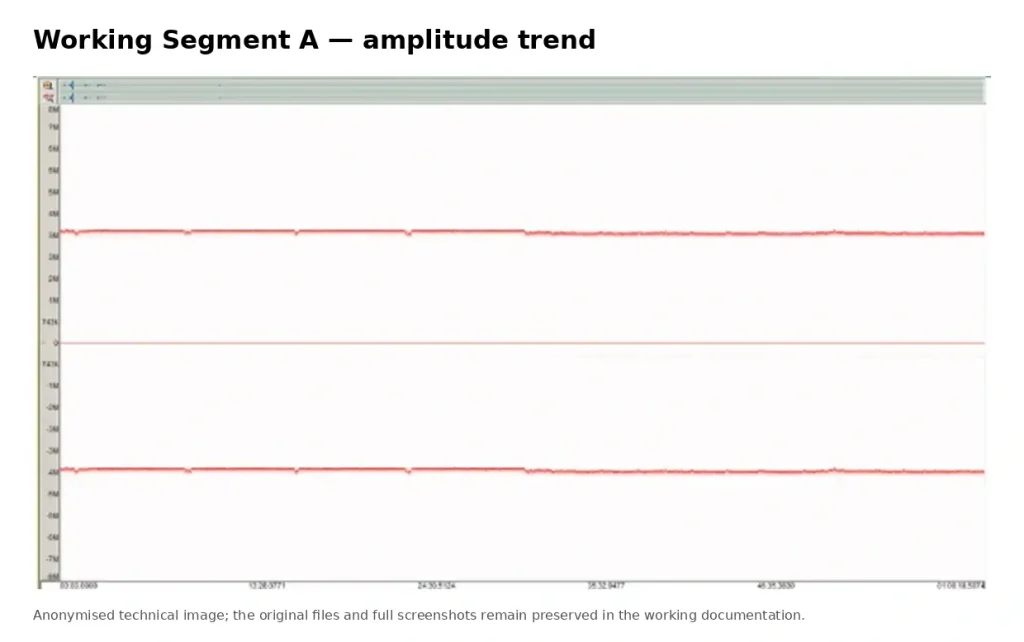
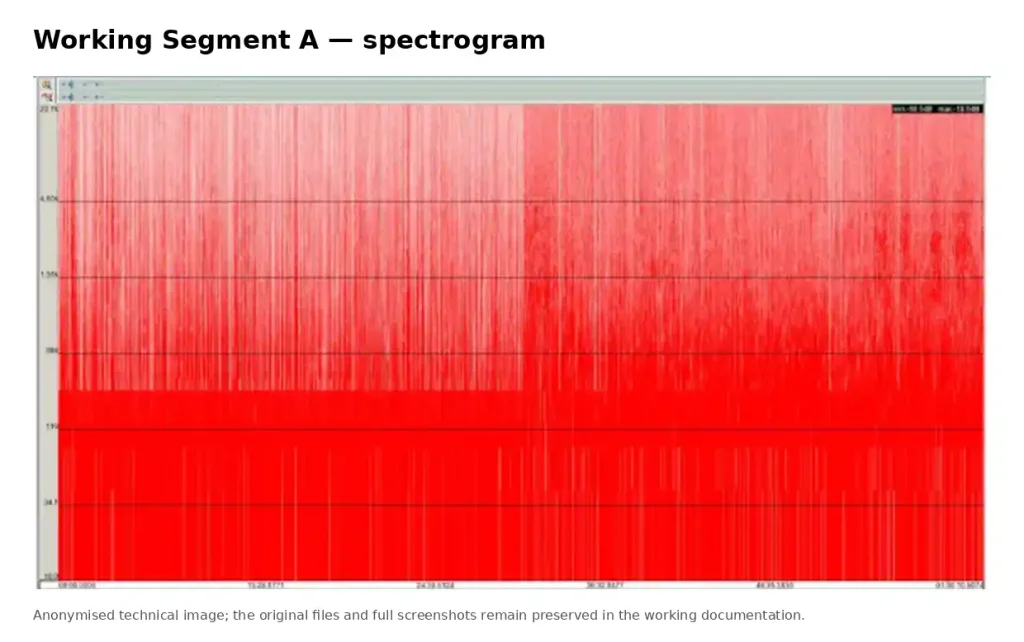
A local window of approximately 5.58 seconds was subjected to waveform statistics: the sample rate was 44,100 Hz and the clipped-sample count was zero. This excludes only full-scale digital clipping in the measured window; it is not evidence of authenticity and does not exclude other forms of processing.
Findings, Conclusion and Limitations
- Parameters extracted with different tools were mutually consistent.
- The structure was compatible with the stated export format, but did not directly document the original device or recording date.
- Critical listening and waveform inspection did not reveal, at the examined points, abnormal transients or macroscopic discontinuities attributable to obvious cut points.
- Local amplitude variations were compatible with acoustic events and changes in ambient noise and were examined using additional checks.
- In the overall view of the segment, no broadband spectral gaps or sharp vertical discontinuities were observed that constituted positive evidence of a digital splice.
Considering metadata, structure, critical listening, waveform, amplitude behavior, spectrogram and local checks jointly, no positive indicators attributable to obvious tampering, cuts or splices were detected at the points examined.
The file was therefore compatible with a temporally continuous audio stream that was subsequently exported to WAV. This conclusion is not a mathematical demonstration that no undetectable intervention ever occurred. Because the examined file was an export, it was not described as the native or “raw” file from the acquisition device.
Anonymized real case. This summary omits names, location, dates, complete hashes, original filenames and details unrelated to authentication. The figures are derivative copies used for explanatory purposes; the originals remain in the working documentation.
What to Send for Audio Authentication
- the native recording or earliest available generation;
- all known versions of the same content, without replacing one with another;
- device name, application, software version and settings, where known;
- transfer, forwarding, export, conversion or processing steps already performed;
- declared recording date, location and conditions where relevant;
- specific time passages and a detailed description of the suspected alteration;
- availability of the recording device or exemplar recordings, where applicable;
- whether a technical report is required and any operational deadline.
Before submission, it is preferable not to rename, trim, normalize, convert or process the file. Preserve the version received and the available provenance information. Transfer arrangements are agreed according to the amount and sensitivity of the material.
Limits of Audio Authentication

- A forwarded, compressed or re-encoded copy may no longer preserve traces from the original file format.
- Missing or editable metadata cannot, by themselves, reconstruct provenance and file history.
- An anomaly may have explanations other than editing and must be assessed in context.
- The absence of positive indicators does not prove in absolute terms that no intervention ever occurred.
- Insufficient quality, short duration, noise, processing and missing contextual information can limit the applicable methods.
- The technical conclusion does not replace legal assessment of admissibility or evidential weight.
Frequently Asked Questions

Is the original file always required?
The native recording or earliest available generation normally offers the greatest range of possible checks. Copies and forwarded versions can still be examined, but conclusions must be limited to the information retained in that specific version.
What can be examined in audio received through WhatsApp or other apps?
The technical information still present in the copy may be examined, including file structure, encoding, accessible metadata and signal characteristics. Compression, forwarding and re-encoding can remove information about the original acquisition and reduce the strength of conclusions. Where available, a version closer to the source is useful for comparison.
Can it be established with absolute certainty that an audio recording was never modified?
Not always. The strength of the conclusion depends on retrievable traces, signal quality, file generation, contextual information and the applicable methods. The outcome should state how far the findings support or oppose the hypotheses considered and should explicitly report limitations.
Does re-encoding or export prove that the recording was manipulated?
No. Re-encoding, export or a container change shows that the file underwent a technical process, but does not by itself prove alteration of the audio content. The examination must determine what transformation occurred, what effects it may have produced and whether the observed findings are also compatible with ordinary saving, forwarding or conversion.
Related Technical Guides
Acquisition and Encoding Artifacts
Compression, transmission, acquisition and conversion can produce artifacts that should not automatically be interpreted as manipulation.
Audio Extracted from Video Containers
Extracting an audio track from a video container can create a derived file. It is important to distinguish simple stream extraction from conversion or re-encoding.
Request a Preliminary Review of the File
Describe the technical concern, state the known provenance of the material and identify any versions, forwarding, exports or conversions. Where possible, preserve the file in the form received and do not modify it before examination.