Forensic Audio Best Practices and Standards: Methodology
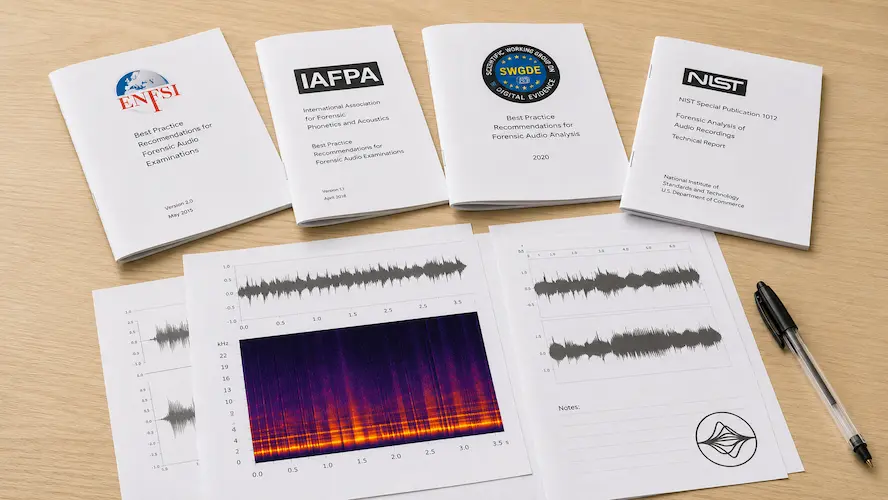
Preservation, working copies, examination, quality control and reporting of audio recordings
Forensic audio best practices define how recorded material is received, identified, preserved, examined and documented in order to answer a technical question. They do not consist of automatically applying the same group of tests to every recording. Relevant forensic audio standards and professional guidance are used according to their scope and to the specific examination required.
The examination path is adapted to the type of material, its known provenance, any transformations it has undergone and the result that can realistically be obtained. Observed data must remain distinct from their interpretation and from the limitations that affect the conclusion.
This page is the site’s cross-cutting methodological reference. Dedicated service pages summarize only the procedures specific to authentication, voice comparison, restoration, deepfake analysis or technical consulting rather than duplicating the general framework in full.
Content reviewed by Roberto Ruggeri, forensic audio specialist.
Preserved material · Defined technical question · Relevant methods · Traceable operations · Proportionate conclusions
Last modified: 23 September 2026
What Forensic Audio Methodology Means
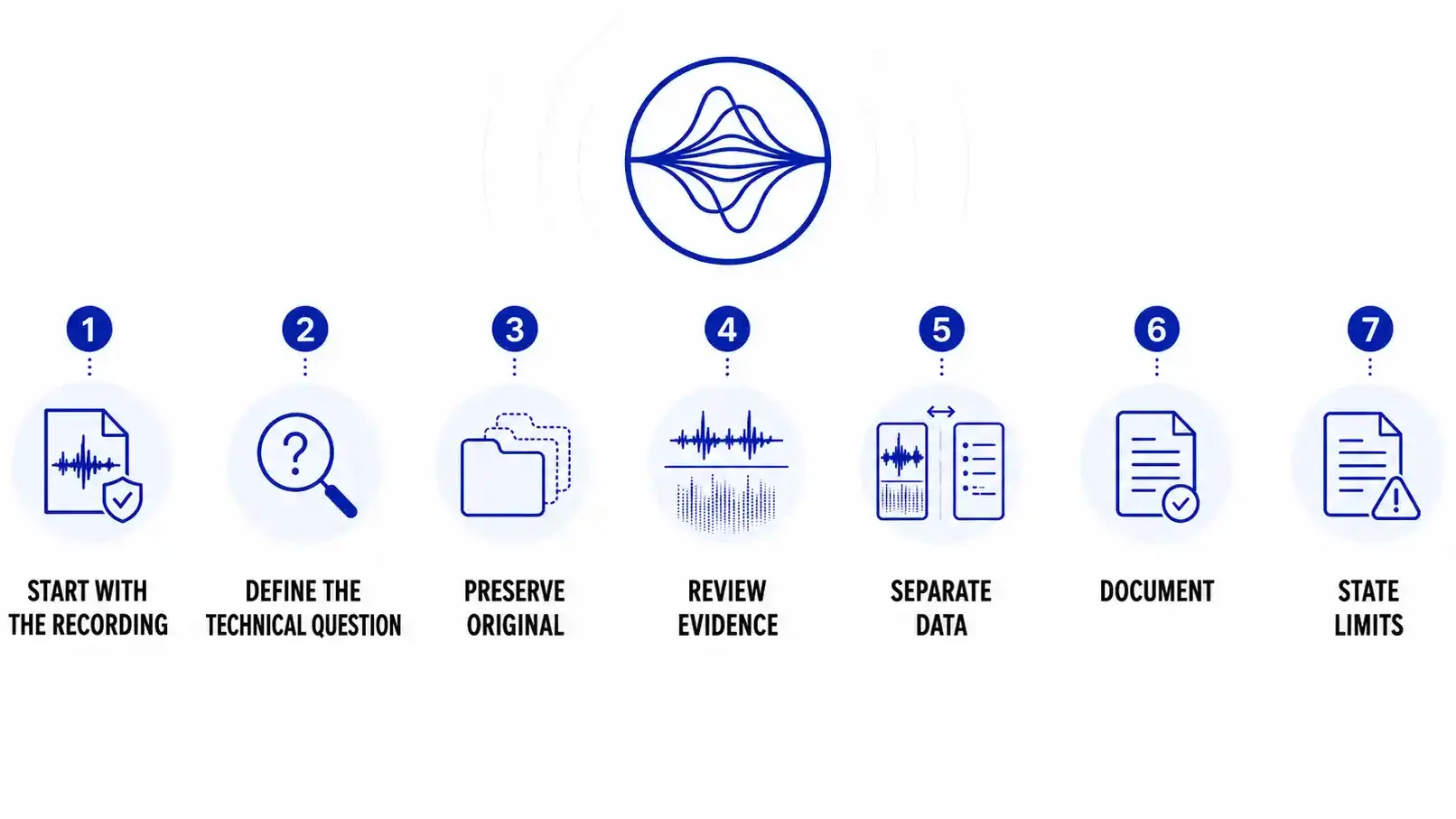
A methodology is the set of criteria that connects the technical question, the available material, the examination steps, evaluation of the results and the final report. It establishes why a check is performed, what data it can produce and what weight those data may reasonably carry in the specific case.
Not every file allows the same examinations. A re-encoded copy may be sufficient for some speech-related assessments but not for direct examination of the original container. A very short recording may be audible but unsuitable for voice comparison. A continuous exported file may still contain material that was generated or inserted before export.
Methodology therefore also means recognizing early when a request should be reformulated, limited or considered technically impracticable. For a general overview of forensic audio work, see the main forensic audio expert page.
Essential Terminology for Audio Files
Correct terminology helps prevent a copy, export or derivative from being assigned characteristics that have not been documented.
| Term | Operational Meaning |
|---|---|
| Native recording file | The file written by the recording device or system when the signal was captured, in the format and with the metadata produced at that stage. |
| Earliest available generation | The version closest to acquisition when the native file or recording device is unavailable. It should not be described as the original without supporting evidence. |
| Verified bitstream copy | A copy containing the same byte sequence, verified by hash. It does not reconstruct device state or external metadata not contained in the file. |
| Working copy | A copy used for technical examination, kept separate from the material received and identified in a traceable manner. |
| Derived file | A result of extraction, decoding, conversion, segmentation, resampling or processing. It should remain linked to its source and should not replace it. |
| Processed file | A version produced by enhancement, filtering or another transformation. It is a technical result, not the evidentiary material as received. |
| Cryptographic hash | An identifier of a byte sequence. It can verify digital identity and integrity, but does not by itself establish origin, authenticity or truthfulness of the content. |
Fundamental Principles of the Examination

Competence, Impartiality and Scope
The practitioner should work within their competence, use tools they can control and recognize when a specialist from another discipline is required. Remuneration and the role of an instructed expert should not depend on the outcome.
Technical Question and Alternative Hypotheses
The request should be translated into technically testable questions. Where the method permits, findings should be evaluated in relation to competing hypotheses rather than by searching only for features that support the initial explanation.
Scientific Literature and Research Review
Where a case raises a physical, acoustic or signal-processing question that can be examined against established research, a targeted scientific literature review may form part of the forensic methodology.
The purpose is not to search for publications that simply confirm an initial interpretation. Relevant peer-reviewed studies, standards and authoritative technical sources are reviewed to determine whether the case-specific observations are consistent with established scientific knowledge, whether alternative mechanisms have been described, and what limitations apply to the interpretation.
Scientific literature is used as a supporting layer of the examination, not as a substitute for analysis of the actual recording. The evidence is examined first on its own technical characteristics; published research is then used, where relevant, to test the physical plausibility of the interpretation and to place the observed features within an appropriate scientific framework.
Where the literature materially contributes to the reasoning, the relevant sources should be identified in the technical report so that the scientific basis of the interpretation can be independently checked. Studies that contradict, qualify or limit the proposed explanation should also be considered rather than excluded.
This approach is particularly useful in cases involving unusual acoustic phenomena, source-mechanism questions, transient events, recording-system behavior or other issues where the interpretation benefits from comparison with established experimental or theoretical research.
A practical example of this approach is presented in Does a Hand Clap Generate a Shock Wave? A Forensic Audio Case Study, where competing acoustic hypotheses, transient analysis, reference material and published research are considered together with explicit limitations.
Preservation and Traceability
The material received should be identified, preserved and kept separate from subsequent copies. Where no formal chain of custody exists, the operational traceability that can actually be documented should be described without presenting it as more complete than it is.
Repeatability and Working Notes
Files, versions, software, settings, intervals, exclusions and methodological decisions should be recorded in sufficient detail for another suitably qualified practitioner to understand the examination path followed.
Bias Control and Review
Contextual information should be limited to what is necessary. Where appropriate, samples or hypotheses may be reviewed separately before joint comparison. Independent technical review is preferable when available and proportionate to the case.
Receipt and Acquisition of Material

Before examination, the native file or earliest available generation should be requested whenever possible. The transfer method should be selected with the aim of preserving content, structure and relevant technical information.
- recording device or application used;
- method of export, download, forwarding or extraction;
- any different versions of the same content;
- original video container, project/session or storage medium, where available;
- declared date, location and recording conditions, distinguishing statements from technically verifiable data;
- time intervals or events under examination;
- reference samples or exemplar recordings, where relevant;
- case documents and existing technical reports needed to understand the question.
Digital transfer should, where practicable, allow hash comparison. Where byte-for-byte identity cannot be verified, the transfer procedure and its limitations should be documented.
The absence of the native file does not automatically prevent every examination. It may, however, exclude or weaken checks concerning the original format, metadata, file history or acquisition device.
Working Copies, Conversion and Segmentation
As an operational rule, the file received should be kept unchanged and technical work performed on a verified copy. Further derivatives should be created only where necessary for the format or tool being used.
- avoid unnecessary re-encoding and resampling;
- where possible, retain sampling rate, channels and bit depth consistent with the source;
- document decoding, conversion, extraction, normalization, gain changes, dither and other applied processes;
- record software, version and relevant settings;
- for segments, record time intervals or initial and final sample positions;
- maintain distinct identifiers for each derived file.
Converting a compressed file to WAV does not restore information removed by the codec. Upsampling or increasing bit depth may change the working format, but does not create acoustic detail that was absent from the source.
Where audio originates from a video container, the procedure should distinguish extraction without re-encoding from conversion. See audio extracted from video for the technical distinction.
Examination Plan and Multilevel Analysis
The examination plan should be defined before interpreting the results and updated when new relevant information emerges. Global review and local examination serve different purposes and should be coordinated.
1. Initial Technical Inspection
Check readability, duration, channels, codec, container, structure, size, accessible metadata and internal consistency of the technical parameters.
2. Critical Listening
Listen to the file in context, recording relevant events, quality, noise, transitions, intelligibility and passages of interest. Graphical representations do not replace listening.
3. Global Analysis
Review waveform, spectrogram, spectrum and temporal behavior across the material to identify overall structure, changing conditions and areas requiring closer examination.
4. Local Analysis
Examine disputed or anomalous passages at an appropriate temporal and frequency scale. A local detail should not be interpreted without its preceding and following context.
5. Cross-Checks and Independent Verification
Where possible, verify a finding through different tools, procedures or data. Exemplar recordings and controlled tests may help distinguish a system artifact from an event specific to the case.
6. Joint Evaluation
Interpret the results together with documented contextual information, alternative hypotheses and limitations. No single image, measurement or software output automatically becomes conclusive.
Real Forensic Audio Case: Comparing Recording Conditions
The Technical Question
In an anonymized real case, the examination compared two hypotheses concerning the position of a recording device during a conversation: a device remaining stationary and exposed at a distance from the speakers, or a device being held close to the body. The objective was to determine which scenario was more compatible with the acoustic characteristics observable in the recording, not to claim an exact device position.
Examination and Reference Material
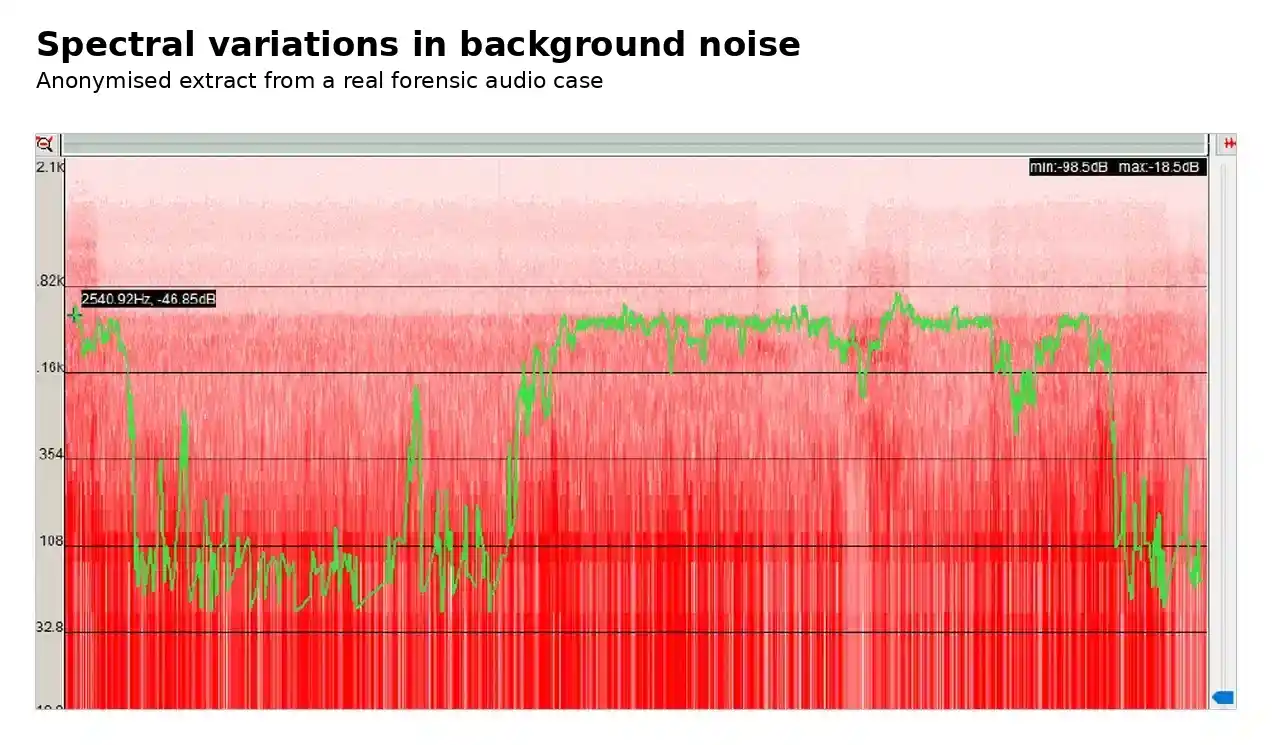
The submitted file was identified with a SHA-256 hash and the technical work was performed on a separate working copy. The examination considered file characteristics, ambient-noise behavior, spectral variation over time, very-low-frequency components, speech proximity characteristics and the relationship between direct sound and reverberation. Thirteen short speech-free intervals distributed through the recording were selected to examine the background independently from speech.
Findings and Limits
The low-frequency components of the ambient noise showed a relatively stable pattern, while more structured variations appeared in the mid-to-high frequency bands. Considered together with the very-low-frequency components and the speech proximity and reverberation characteristics, the combined observations were more compatible with changes in microphone orientation and partial shielding.
Within the limits of the available material and of the two hypotheses submitted, the device-close-to-body scenario was more consistent with the combined findings. The examination could not determine an exact position or distance. The conclusion therefore remained a comparison between the two proposed scenarios and was not based on any single graph or parameter.
Real anonymized case. Names, case references and unnecessary identifying information have been removed. This summary does not replace the complete technical report.
Metadata, Waveform and Spectrogram
Metadata and file structure describe the file examined, but they should not be interpreted beyond their actual scope. A timestamp may reflect a filesystem attribute or an export stage rather than the moment at which the sound was recorded.
Where appropriate, results from different tools should be compared and the mathematical consistency of duration, sample count, bitrate and audio parameters checked. The absence of descriptive fields does not demonstrate manipulation; their presence does not automatically establish genuineness.
Waveforms and spectrograms make events, energy and changes over time visible, but they do not by themselves ‘show an edit’. Codec artifacts, natural transients, filtering, noise and environmental changes can produce superficially similar appearances.
For time-frequency interpretation, see how to read a spectrogram in forensic audio. Effects introduced by acquisition, compression and conversion are discussed in audio artifacts.
Software, Automation and Validation
A method is not defined by the name of a software package. The practitioner should understand the function being used, the required data, relevant settings, possible sources of error and the actual meaning of the output.
- record software, version and relevant parameters;
- test new or unfamiliar tools on known data before case use;
- check updates, codecs, dependencies and changes in functionality;
- use controls or reference data representative of real case conditions;
- calibrate or verify instruments where a numerical result has decisive importance;
- do not treat automated scores or classifications as stand-alone conclusions;
- document out-of-domain conditions, errors and discordant results.
For proprietary or artificial-intelligence systems, transparency, validation data, thresholds, robustness to codecs and noise, and the ability to generalize beyond training conditions should also be considered.
Application to Different Forensic Audio Examinations
The common principles remain the same, but each type of examination requires questions and checks specific to its purpose.
| Examination | Methodological Focus |
|---|---|
| Audio Authentication | Provenance, structure, recording and post-production traces, global and local checks, and alternative hypotheses. |
| Forensic Voice Comparison | Separate review of samples, suitability, comparability, phonetic-linguistic and acoustic analysis, variability and typicality. |
| Forensic Audio Restoration | Preservation of the source, progressive treatment, input-output comparison, residue review and control of processing artifacts. |
| Deepfake Audio Analysis | Hypotheses involving synthesis, conversion, replay and imitation; documented detection tools; domain checks and alternative explanations. |
| Legal Audio Consulting | Definition of the question, file inventory, review of existing technical material, selection of further examinations and reasoned observations. |
This section directs readers to the specialist service pages without duplicating their content. Methodology remains the cross-cutting reference for preservation, documentation, quality control and reporting.
Quality Control and Technical Review
- verify identifiers and versions of the files used;
- check consistency between notes, tables, images and conclusions;
- repeat decisive steps or compare them through an independent procedure;
- reconsider excluded intervals and possible tracking or selection errors;
- assess explanations contrary to the initial interpretation;
- use review by a second competent practitioner where available and proportionate;
- correct and communicate significant errors promptly if identified.
Review should not become a formal exercise in confirmation. It should test whether the procedure, data and language of the report are consistent with the actual strength of the evidence.
Technical Forensic Report and Documentation
The report should allow the reader to understand what was received, what was done, what results were obtained and why the conclusion has the stated scope.
- assignment, technical question and scope of the examination;
- inventory of material and available identifiers;
- declared provenance and known transformations;
- working copies and derived files used;
- methods, tools, versions, settings and relevant intervals;
- observed results and checks performed;
- interpretation and alternative explanations;
- limitations, assumptions and examination conditions;
- conclusion stated in clear and technically proportionate terms;
- attachments needed to document decisive steps.
Observation, interpretation and conclusion are not synonyms. A line in a spectrogram is an observation; a possible source is an interpretation; the weight it carries in relation to the technical question belongs to the overall conclusion.
A technical report does not automatically determine admissibility, liability or evidential weight. Those issues belong to the relevant legal framework and competent authority.
Conclusions, Uncertainty and Limitations

A technically appropriate conclusion may express compatibility, incompatibility, the presence of indicators, the absence of detected relevant indicators, or insufficiency of the material. An inconclusive outcome is methodologically valid when the data do not support a stronger answer.
- “No indicators were detected” does not mean “the event could not have occurred.”
- A matching hash demonstrates digital identity between two files, not authenticity of content before the hash was calculated.
- An anomaly does not automatically demonstrate an edit, deepfake or manipulation.
- Voice similarity does not amount to certain speaker identification.
- Cleaner audio does not demonstrate that a particular phrase was spoken.
- Percentages and scores are meaningful only where the method, calibration and reference data are appropriate and disclosed.
Quality, duration, compression, file history, transmission channel, language, noise and availability of comparison material can reduce the scope of conclusions and should be reported explicitly.
Confidentiality and Handling of Case Material
Recordings and documents may contain private conversations, personal data or sensitive information. Access should be limited to those necessary for the assignment, and transfer arrangements should be proportionate to the nature of the material.
- separate material received, working copies and final products;
- agree procedures for submission, delivery, retention and return;
- avoid unnecessary disclosure of names, content or images;
- anonymize public case material and check relevant NDAs and permissions beforehand;
- document accesses, transfers or copies that are relevant to the assignment.
These are general operational principles and do not replace legal or contractual obligations applicable to a particular case.
Official Methodological References
The following documents serve different purposes and are not applied indiscriminately to every assignment.
- ENFSI Best Practice Manual for Digital Audio Authenticity Analysis — FSA-BPM-002, Issue 001— digital authenticity, hypotheses, recording and post-production traces, interpretation and reporting.
- ENFSI Best Practice Manual for the Methodology of Speaker Comparison — FSA-BPM-003, Issue 001— suitability and comparability of samples, speaker analysis and formulation of conclusions.
- SWGDE Best Practices for Forensic Audio — 08-A-001-2.5, Version 2.5— receipt, documentation, handling and general examination of forensic audio evidence.
- SWGDE Best Practices for Enhancement of Digital Audio — 20-A-001-2.0— progressive processing, input-output comparison, residue review and avoidance of over-processing.
- SWGDE Core Competencies for Forensic Audio — 10-A-001-3.3, Version 3.3— discipline-specific knowledge and competencies for forensic audio practitioners.
- IAFPA Code of Practice (2020)— integrity, competence, documentation, bias mitigation, validation, review and communication of limitations in forensic phonetics and acoustics.
- NIST-OSAC Forensic Science Standards Library— current landscape of forensic science standards, guides, practices and terminology.
Citing these references does not imply certification, accreditation, endorsement, membership or affiliation. Technical documents should be rechecked because versions can be revised, replaced or archived.
Frequently Asked Questions About Forensic Audio Methodology

Does a hash prove that a recording is authentic?
No. It can demonstrate that two byte sequences are identical, or that a file has not changed relative to a recorded hash. It does not demonstrate that the content was authentic before the hash was calculated.
How does methodology change when only a copy or forwarded audio is available?
The copy is examined for what it still contains, while provenance, known transfer steps and transformations are documented. Examinations that require the native file or an earlier generation are excluded or limited, and those limitations should be reflected in the conclusion.
Are the same tests always applied?
No. Preservation, traceability, documentation and limitation control remain common principles; specific examinations depend on the technical question and the material available.
Is review by a second expert always required?
It is recommended for significant analyses and conclusions when a suitably competent practitioner is available and the assignment permits it. If it is not performed, it should not be stated or implied.
Does citing ENFSI or SWGDE mean that the practitioner is accredited?
No. It means that relevant public documents are being referenced. Accreditation, certification and membership are separate conditions that require separate evidence.
Does good methodology guarantee a conclusive answer?
No. It provides a more transparent and controllable examination path. If the material is insufficient, the technically correct conclusion may remain limited or inconclusive.
Further practical questions are covered in the Audio Forensics FAQ.
Request an Assessment of the Available Material
Describe the file available, its known provenance, the technical question that needs to be clarified and any relevant deadline. The preliminary assessment helps define the appropriate examination, the materials required and the limitations that are already apparent.