Technical case study by Roberto Ruggeri, forensic audio specialist. Last modified: 23 September 2026
Yes. A hand clap can generate a weak shock wave, but that does not make a shock-like transient a unique forensic fingerprint of hand clapping. Research on hand-clap acoustics shows that rapid compression and expulsion of air between the hands can produce weak shock behavior, while hand shape, impact speed, cavity geometry, distance and the recording environment can substantially change the resulting signal.
This distinction became important in an anonymized forensic audio case involving eight disputed impulsive sounds. One hypothesis was that the events were hand claps produced during animated speech; the competing hypothesis was that they were impacts involving hand-to-face contact. A separately recorded known hand clap was available as reference material.
The case therefore provides two levels of analysis in one page: first, what scientific research actually establishes about hand clap shock waves and hand-clap acoustics; second, how waveform, spectrogram and spectral observations were used cautiously in a real source-comparison problem.
What Does “Hand Clap Shock Wave” Mean?
A shock wave is not simply a loud sound. In nonlinear acoustics, it involves a steep pressure transition that differs from an ordinary small-amplitude linear sound wave. In the case of a hand clap, the relevant phenomenon is weak and short-lived; it should not be confused with the large far-field shock front associated with a sonic boom.
Fletcher (2013) modeled the aerodynamics of hand clapping and concluded that shock waves are generated in nearly all hand claps, with an additional Helmholtz-type resonance when the hands form a domed cavity. In his model, a relatively flat clap produces a sharp broadband sound that can extend to about 10 kHz, whereas a more domed clap can show a stronger low-frequency resonant contribution.
That result does not mean that every recorded clap must display the same waveform or spectrum. Repp (1987) demonstrated substantial spectral variation associated with hand configuration, and later measurement research has shown that source-receiver distance, environment and clap technique can further change the observed signal.
Hargather, Settles and Madalis used high-sensitivity schlieren imaging to visualize loud sounds and weak shock phenomena in air. Hand clapping was among the common impulsive events examined. Their work supports the physical reality of weak nonlinear fronts associated with some claps, but it was not a forensic source-classification study.
More recently, Fu et al. (2025) investigated human hand clapping using in vivo measurements, experiments, finite-element simulations and theoretical modeling. Their results describe a coupled system involving airflow, hand-cavity resonance and collision dynamics. Material elasticity has a strong effect on the temporal evolution of the signal, while cavity geometry influences resonant behavior.
The forensic consequence is important: a hand clap is a variable mechano-acoustic source, not a fixed template. A sharp onset, broadband energy or an N-like early transient can be compatible with a hand clap, but no one of those features proves source identity by itself.
The Forensic Question in This Case
The questioned recording contained eight short impulsive events whose interpretation was disputed. The technical task was deliberately narrower than the legal dispute. It was not to determine responsibility, intent, credibility or the outcome of the proceeding. It was to assess which of two source hypotheses was better supported by the acoustic evidence available in the recording.
- H1 — Hand clap: the questioned impulses were hand claps produced during animated speech.
- H2 — Hand-to-face impact: the questioned impulses were impacts involving hand-to-face contact.
A separately recorded known hand clap was available for comparison. No matched hand-to-face impact exemplar recorded under equivalent conditions was available.
That asymmetry matters. The absence of a matched H2 reference was treated as a limitation, not as evidence for H1. No universal acoustic signature for hand-to-face impact was assumed.
Material Examined and Analytical Controls
All eight questioned events were examined in the underlying work. This public case study reproduces selected measurements and plots from Questioned Segment 4 and Questioned Segment 7, together with the reference clap. The remaining six events contributed to the original technical assessment but are not reproduced publicly.
For software compatibility, derived 16-bit, 44.1 kHz WAV working files were created for analysis. They were treated as derived analytical representations rather than bit-identical replacements for the submitted evidence.
No denoising, filtering or enhancement was applied to the questioned impulses before the measurements shown here. Segment boundaries were placed at suitable zero crossings immediately before transient onset to reduce boundary artifacts. The working documentation reports an approximate timing tolerance below 10 ms associated with alignment and display resolution.
Speech-free room-tone intervals distributed through the recording were also reviewed as a supplementary control. They were used to understand background behavior and recording context, not as an independent source classifier.
General principles for preserving evidence, distinguishing working copies and documenting examination steps are covered separately in the Forensic Audio Methodology and Best Practice References.
How the Impulsive Sounds Were Compared
The analysis was built around convergence rather than a single “signature”. The main comparison layers were:
- Critical listening to the questioned events and their surrounding context.
- Time-domain examination of onset, duration, waveform morphology and decay.
- Descriptive measurements including crest factor, zero crossings and clipping checks.
- Spectrogram examination of onset, broadband distribution and time-frequency decay.
- Magnitude-spectrum comparison as supporting evidence rather than a stand-alone classifier.
- Higher-resolution review of the first milliseconds of selected transients.
- Comparison with the known hand-clap reference.
- Evaluation against scientific literature on hand-clap mechanics and source variability.
Recording-system behavior, compression, microphone geometry and room reflections can all modify impulsive details. When a short event may instead be technical rather than acoustic in origin, that is a separate problem addressed in Audio Artifacts in Forensic Recordings.
Selected Case Measurements
The following values reproduce selected measurements from the examination. They are descriptive observations from this case and are not source-specific thresholds.
| Item | Duration (s) | Crest factor | Zero crossings | Clipped samples |
|---|---|---|---|---|
| Reference hand clap | 0.3598 | 12.99 | 3014 | 0 |
| Questioned Segment 4 | 0.2474 | 5.34 | 824 | 0 |
| Questioned Segment 7 | 0.3461 | 10.18 | 781 | 0 |
The public table reproduces the values recorded in the working documentation. Because this article does not reproduce the original software configuration, channel-selection rule or zero-crossing algorithm, the crest-factor and zero-crossing values should be treated as descriptive case measurements rather than independently reproducible metrics.
The values were not converted into a numerical similarity score. Hand claps vary with hand geometry, speed, tissue properties, distance, room acoustics and recording chain, so a single fixed threshold would not be scientifically justified by the literature used here.
The comparison was qualitative and uncalibrated. No likelihood ratio, validated classification threshold or case-specific error rate was available.
Spectrogram: Broadband Impulsive Structure
The spectrograms were reviewed for onset, distribution of energy across frequency and decay. The selected questioned example shows an abrupt broadband transient with relatively short time-frequency decay in the displayed window.
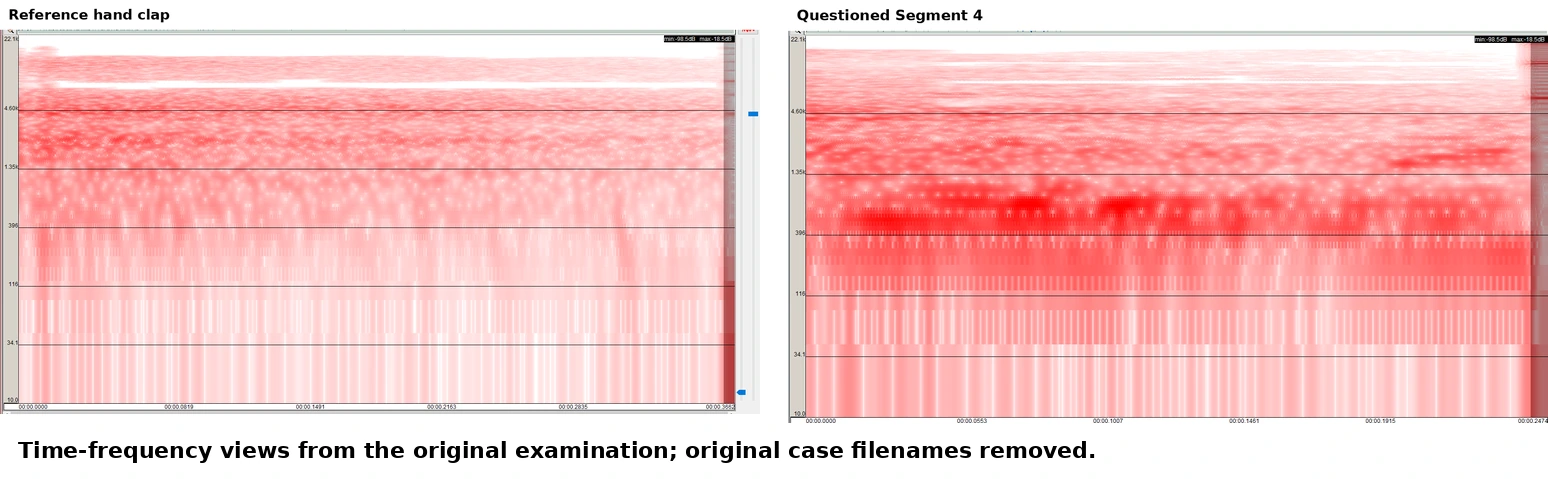
This is compatible with short impulsive excitation, including a hand clap, but the spectrogram does not identify the source by itself. A broadband vertical event can also arise from other physical impacts or technical phenomena. The separate guide How to Read a Spectrogram in Forensic Audio covers display interpretation and its limitations.
Time-Domain Transient Morphology
Questioned Segment 4 was examined at higher temporal resolution because the earliest part of an impulsive signal can preserve information about how rapidly energy was released.
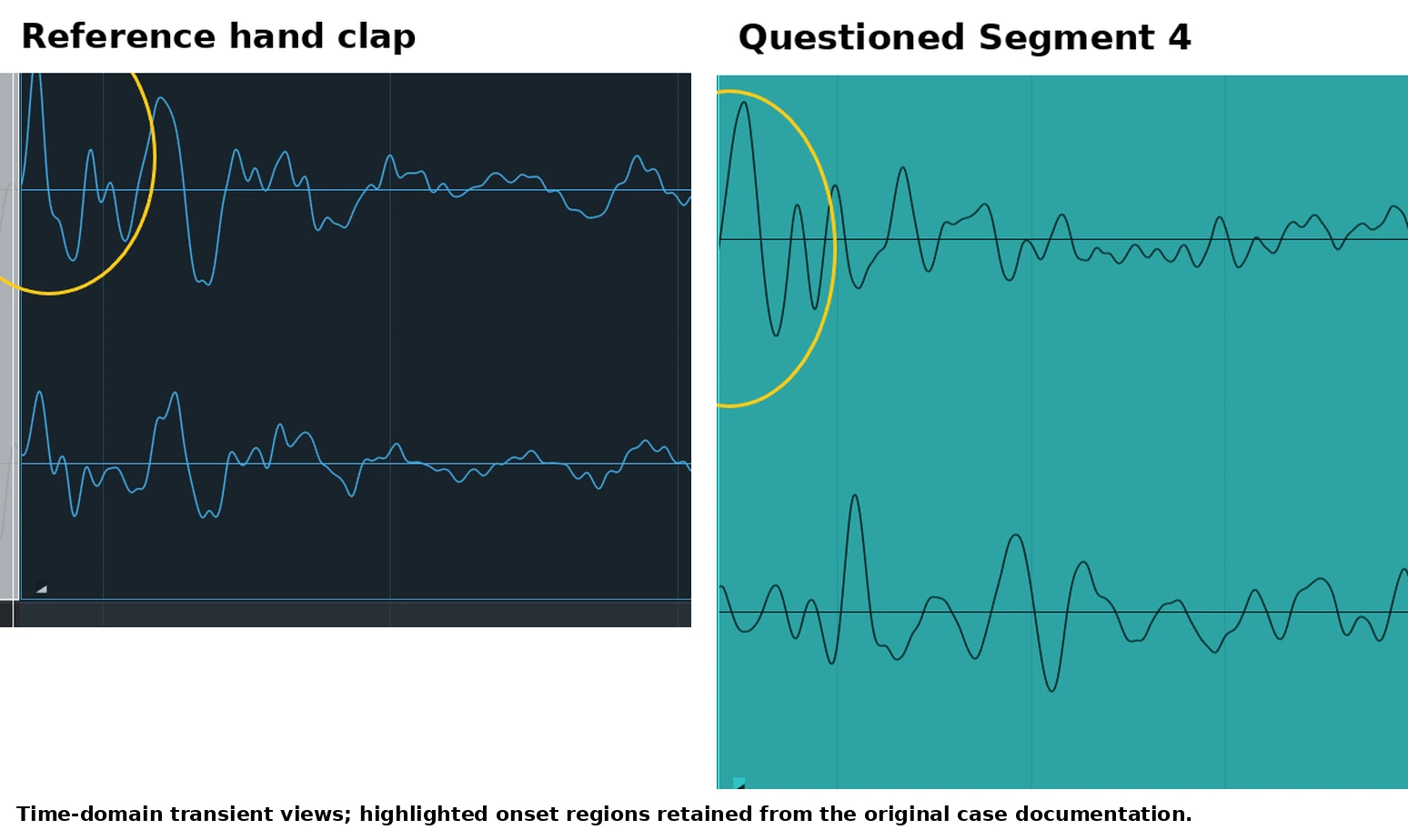
The early waveform in Segment 4 can cautiously be described as having an N-like or bipolar morphology. That descriptive resemblance is not equivalent to identifying a classical far-field sonic-boom N-wave, and it is not an exclusive hand-clap fingerprint.
Its relevance in this case was comparative: it was considered together with the known reference clap, broadband spectral behavior, event duration, decay and the recurring characteristics observed across the questioned events.
Magnitude Spectrum Comparison
The magnitude spectrum added another descriptive layer to the comparison.
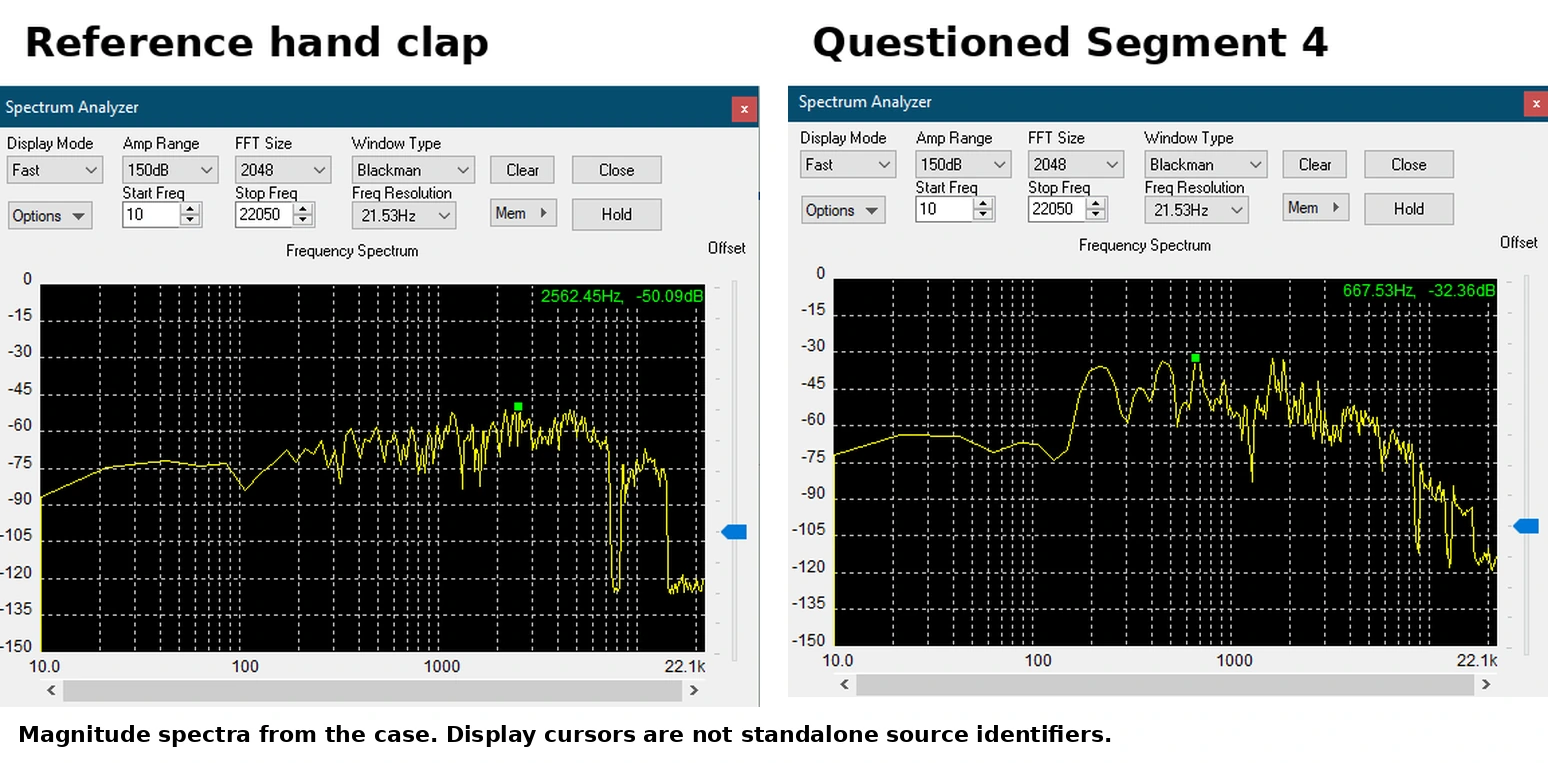
The selected examples show broadband energy consistent with short impulsive excitation. No universal spectral rule was applied. Spectrum, onset morphology and decay were interpreted together and against the known reference, not as independent proof of source.
What Scientific Research Supports — and What It Does Not
| Research finding | What it supports in this case | What it does not establish |
|---|---|---|
| Repp (1987): clap spectra vary with hand configuration. | A known clap should not be treated as an invariant template. | A universal spectrum that identifies all claps. |
| Fletcher (2013): rapid hand closure can generate weak shock behavior; domed configurations can add cavity resonance. | Physical plausibility of a sharp, broadband, shock-like onset in a hand clap. | That any N-like transient must be a hand clap. |
| Hargather et al. (2010): weak shock phenomena from common loud impulsive sources can be visualized in air. | The phenomenon is physically real, not merely a graphical artifact. | A validated forensic classifier. |
| Papadakis & Stavroulakis (2020): clap source characteristics depend on configuration, distance and environment. | Recording geometry and clap technique must be retained as limitations. | Exact source equivalence between a reference clap and a questioned event. |
| Fu et al. (2025): airflow, cavity resonance and collision dynamics jointly shape clap sound. | A multi-mechanism interpretation of the transient and decay. | A hand-clap-vs-slap decision rule. |
This distinction is central to the forensic interpretation. The literature supports the physical plausibility of clap-compatible features; the source conclusion must still come from the actual evidence and the competing hypotheses in the case.
Evaluation of the Competing Hypotheses
H2 was not rejected in advance. The questioned events were examined to determine whether their combined behavior was more compatible with the known hand-clap reference or with the alternative impact interpretation.
No categorical rule such as “a bipolar onset proves a clap” or “a low-frequency thud proves a hand-to-face impact” was used. The literature reviewed for this case does not support rules of that kind.
Within the examined material, the recurring combination of abrupt onset, short impulsive decay, broadband energy, clap-compatible early transient morphology and comparison with the known hand-clap reference provided stronger support for H1 than for H2.
This was a relative, case-specific assessment, not an absolute source identification.
Why No Matched Hand-to-Face Reference Was Used
No matched recording of hand-to-face contact under equivalent conditions was available. Deliberately reproducing potentially harmful contact on a person solely to create evidential reference material would raise obvious ethical and safety concerns and would not be an appropriate routine forensic reference-acquisition procedure.
Controlled non-harmful models or validated datasets may sometimes be useful if they are genuinely representative. No sufficiently comparable validated H2 reference was available in this examination.
The absence of that exemplar therefore reduced the strength of the comparison; it did not count as positive evidence for H1.
Limitations
- The precise microphone type, placement and calibration were not available.
- Source-to-microphone distance and room acoustics can modify transient morphology, spectral balance and decay.
- Some questioned events occurred with incidental speech inside the analysis window.
- A known hand-clap reference was available, but no matched hand-to-face impact exemplar recorded under equivalent conditions was available.
- The analytical WAV files were derived working representations created for software compatibility.
- This public article reproduces only selected questioned events, although all eight were considered in the underlying examination.
- No validated universal acoustic classifier for the two source classes was identified in the literature relied upon for this case.
Forensic Conclusion
The conclusion did not depend on one graph, one number or the mere presence of a shock-like waveform. It depended on the convergence of observations across the questioned events, comparison with a known hand clap, examination of alternative explanations and scientific literature describing the physical variability of hand-clap sound.
Within the stated limitations, the observed acoustic evidence supported the hand-clap hypothesis more strongly than the competing hand-to-face impact hypothesis considered in this case.
According to information provided after the examination, the technical findings were used in support of the defense interpretation of the disputed sounds. The judgment itself is not reproduced or analyzed here, and no claim is made that the forensic audio examination determined the legal outcome.
What This Case Demonstrates
A hand clap can generate a weak shock wave, but “shock wave present” is not a forensic source label. Source interpretation requires the complete pattern of evidence.
This case illustrates a more defensible sequence: define competing hypotheses, preserve the evidence/working-copy distinction, examine multiple complementary signal characteristics, compare relevant reference material, test the physical interpretation against scientific research, and state limitations that prevent overclaiming.
For broader evidence-handling and reporting principles, see the Forensic Audio Methodology and Best Practice References.
Scientific and Methodological References
- Repp, B. H. (1987). The Sound of Two Hands Clapping: An Exploratory Study. Journal of the Acoustical Society of America, 81(4), 1100–1109. DOI: 10.1121/1.394630.
- Fletcher, N. H. (2013). Shock Waves and the Sound of a Hand-Clap — A Simple Model. Acoustics Australia, 41(2), 165–168.
- Hargather, M. J., Settles, G. S. & Madalis, M. J. (2010). Schlieren Imaging of Loud Sounds and Weak Shock Waves in Air Near the Limit of Visibility. Shock Waves, 20, 9–17.
- Papadakis, N. M. & Stavroulakis, G. E. (2020). Handclap for Acoustic Measurements: Optimal Application and Limitations. Acoustics, 2(2), 224–245.
- Fu, Y., Kiyama, A., Liu, G., Zhang, L. & Jung, S. (2025). Revealing the Sound, Flow Excitation, and Collision Dynamics of Human Handclaps. Physical Review Research, 7, 013259.
- SWGDE — Best Practices for Forensic Audio, Version 2.5.