Technical guide by Roberto Ruggeri, forensic audio specialist. Last modified: 23 September 2026
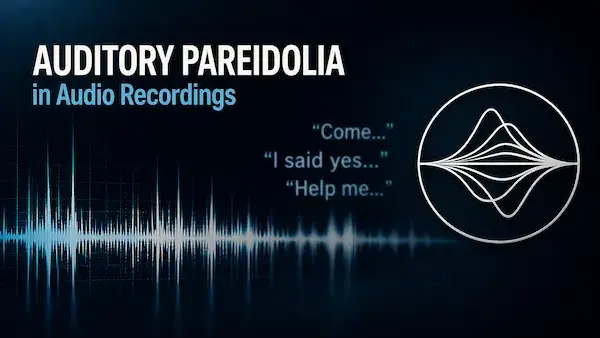
Auditory pareidolia means perceiving a meaningful voice, word or speech-like pattern in ambiguous external sound. An acoustic stimulus is genuinely present, but the specific verbal content perceived by the listener may be more definite than the recording itself can support.
This can occur in noise, degraded recordings, reverberant material, compressed audio or other signals containing weak and incomplete speech-like cues. A fragment that initially sounds uncertain may begin to resemble a particular word or phrase after a transcription is suggested or after repeated listening.
In forensic audio, the central question is not simply “What do I hear?” but “Which parts of that interpretation are supported by stable acoustic information, and which may depend on expectation, context or perceptual completion?” For the distinction between measurable acoustic information and human perception, see Human Hearing and Sound Perception.
What Is Auditory Pareidolia? Meaning and Examples
Pareidolia is the recognition of familiar meaning in ambiguous sensory input. In the auditory domain, the perceived pattern may be a voice, word, phrase, melody or other familiar sound emerging from material that does not uniquely specify that interpretation.
The shorter expression audio pareidolia is sometimes used informally for the same idea in recordings, while the scientific literature cited on this page uses the term auditory pareidolia.
Typical examples include speech-like impressions in broadband noise, faint environmental recordings, static, distant reverberant audio or heavily degraded speech. The important point is not that the listener is “imagining sound from nothing”: a real external stimulus is present. The uncertainty concerns what that stimulus actually supports.
This also means that not every unclear recording is an example of auditory pareidolia. Real speech may be partly masked, distorted or incomplete while still preserving enough acoustic information for some words to be understood correctly. The analytical task is to determine how strongly the available signal constrains the proposed interpretation.
Auditory Pareidolia, Phonemic Restoration and Hallucination Are Different
| Phenomenon | What is present | Main distinction |
|---|---|---|
| Auditory pareidolia | Ambiguous external sound or degraded acoustic material. | A meaningful voice or phrase is perceived even though the signal may not uniquely support that interpretation. |
| Phonemic restoration | Actual speech with a phonetic segment masked or replaced by another sound. | The auditory system perceptually fills in missing speech using acoustic and linguistic information. |
| Auditory hallucination | A corresponding external auditory stimulus is not required in the classical clinical definition. | The percept is less constrained by an external sound source. This page does not make clinical assessments. |
| Speech intelligibility | Speech information that is actually present in the recording. | The question is how accurately verbal content can be understood, not whether a speech-like pattern can be perceived. |
The distinction from phonemic restoration is important. Samuel’s experiments showed that listeners can perceptually restore phonemes replaced by noise, and later work has described this as an interaction between bottom-up acoustic information and higher-level linguistic expectations. That is related to perceptual completion, but it is not identical to perceiving a word or voice in an ambiguous, non-specific sound pattern.
What Research Shows About Auditory Pareidolia
The most directly relevant experimental study for this topic is Nees and Phillips’ Auditory Pareidolia. They compared reports of voices in purported electronic voice phenomena, actual speech, acoustic noise and degraded speech while manipulating the contextual information given to participants.
A paranormal prime increased the proportion of trials in which participants reported hearing voices in both the ambiguous EVP material and degraded speech. When a voice was reported in the EVP stimuli, agreement about the verbal content was low.
The important point for forensic interpretation is not the paranormal context itself. The experiment demonstrates that contextual priming can influence whether listeners report a voice in ambiguous material, while listeners may still disagree substantially about what was supposedly said.
A preregistered study by Szymanek, Homan, van Elk and Hohol reached a related conclusion using a signal-detection framework. Expectations shifted response bias in voice detection, and the effect of expectation was stronger when sensory information was less reliable. In practical terms, weaker acoustic evidence leaves more room for prior expectations to influence the decision that a voice is present.
These findings do not establish that any particular disputed recording is an instance of pareidolia. They support a narrower and more defensible proposition: expectation and sensory uncertainty can measurably influence reported voice perception.
Why Ambiguous Sounds Can Be Heard as Words or Voices
Speech perception combines information arriving from the acoustic signal with expectations derived from language, context and recent listening history. When acoustic cues are strong, they constrain interpretation tightly. When they are weak, masked or incomplete, more than one verbal interpretation may remain compatible with the signal.
This does not mean that perception is arbitrary. Even ambiguous material contains acoustic structure. The issue is that incomplete structure may support several plausible readings, while a listener’s attention becomes increasingly organized around one of them.
For that reason, confidence and acoustic support should not be treated as synonyms. A listener may become highly confident in a phrase that remains poorly constrained by the recording.
Suggested Wording, Priming and Repeated Listening
One of the most important practical risks arises when the listener is told in advance what they are expected to hear. A proposed transcription can direct attention toward particular timing, syllabic or spectral cues and make a previously uncertain sequence seem more coherent.
Repeated listening can strengthen this effect. Once a verbal hypothesis has been adopted, subsequent listening may preferentially reinforce cues that fit it while competing interpretations receive less attention.
Carter and Bidelman demonstrated a related contextual effect in categorical speech perception: acoustically identical speech tokens near a category boundary could be categorized differently depending on recent stimulus history. Their experiment was not a forensic pareidolia study, so it should not be used as a universal explanation for repeated listening. Its relevance is narrower: speech categorization can depend on perceptual context even when the acoustic token has not changed.
Conditions That Increase the Risk of Over-Interpretation
Expectation-driven interpretation becomes especially important when the signal leaves substantial uncertainty. Warning conditions include:
- very low signal-to-noise ratio;
- distant, reverberant or partially masked speech;
- short segments with little phonetic or linguistic context;
- compression, transmission or processing artifacts that create speech-like fragments;
- repeated listening after a disputed transcription has already been supplied;
- substantial disagreement between listeners about the wording;
- a phrase becoming convincing only after aggressive processing or extensive prompting.
None of these conditions proves auditory pareidolia. They indicate that a reported phrase should be evaluated against the acoustic evidence rather than accepted from subjective confidence alone.
Why Auditory Pareidolia Matters in Forensic Audio
In a legal or investigative context, a weak passage may be assigned substantial evidential significance. The danger is that the process can move too quickly from an observation —“there appears to be a voice-like event”— to a specific claim about what was said.
A useful forensic review keeps four levels separate:
| Level | Example |
|---|---|
| Observation | A low-level speech-like segment is audible in a defined interval. |
| Interpretive hypothesis | The segment may contain spoken material. |
| Specific transcription | A particular word or sentence is proposed. |
| Strength of support | The available phonetic and acoustic cues support, fail to distinguish, or contradict that wording. |
If several transcriptions remain acoustically plausible, or if the necessary phonetic cues are absent, the technically appropriate result may be that the passage is ambiguous or insufficient for a reliable verbatim interpretation.
General principles for separating observation, interpretation and conclusion are covered on the Forensic Audio Methodology and Best Practice References page.
How to Reduce Bias When Reviewing Ambiguous Audio
Bias control does not require pretending that context never exists. It requires documenting when a proposed interpretation entered the review process and avoiding unnecessary suggestion before an initial assessment.
- Preserve the earliest available recording and distinguish it from processed derivatives.
- Document any transcription or wording that was supplied before listening.
- Where practical, perform an initial unguided review before comparing the disputed wording.
- Review the passage in its surrounding context rather than as an isolated loop.
- Keep alternative plausible interpretations available instead of forcing a binary choice prematurely.
- State clearly when the material does not support a reliable verbal conclusion.
If a phrase becomes recognizable only after the proposed wording is supplied, that dependency is relevant contextual information. It does not automatically invalidate the interpretation, but it reduces the value of subjective confidence as independent support.
Can a Spectrogram Confirm the Words?
A spectrogram can show when energy occurs, where it is concentrated in frequency and whether the signal contains harmonic, broadband or transient structure. Where recording quality permits, it can support phonetic examination and help establish whether a passage contains features compatible with speech.
It is not a visual word detector. No single spectrogram pattern establishes a complete word or sentence, especially when the signal is weak, overlapped or heavily degraded. For the separate question of time-frequency interpretation, see How to Read a Spectrogram in Forensic Audio.
Does Audio Enhancement Solve the Problem?
Enhancement can sometimes improve audibility by reducing interference, balancing levels or making existing speech components easier to review. It cannot recreate verbal information that was never captured or was irreversibly lost.
Processing can also alter weak components or introduce artifacts, particularly when aggressive algorithms are used. A phrase that seems clearer only in a processed derivative should therefore be checked against the unprocessed reference and the documented processing history.
The separate technical question of intelligibility and processing belongs to Forensic Audio Restoration.
When the Correct Conclusion Is “Ambiguous”
An inconclusive result is not a failure of analysis. It may be the most defensible conclusion when:
- key phonetic cues are masked, absent or unstable;
- several competing phrases fit the residual signal;
- listener confidence depends strongly on a prior transcription;
- different versions or processing chains produce materially different impressions;
- the fragment is too short or too degraded to support a reliable verbal determination.
The evidential question is not whether one wording can be imagined from a fragment, but whether the recording contains enough stable information to support that wording over realistic alternatives.
If the dispute concerns cuts, splices, insertion or other possible modification of the recording rather than the interpretation of ambiguous speech, that is a different question and belongs to Audio Authentication.
Scientific and Authoritative Sources
- Nees, M. A. & Phillips, C. (2015). Auditory Pareidolia: Effects of Contextual Priming on Perceptions of Purportedly Paranormal and Ambiguous Auditory Stimuli. Applied Cognitive Psychology, 29(1), 129–134. DOI: 10.1002/acp.3068.
- Szymanek, P., Homan, M., van Elk, M. & Hohol, M. (2024). Effects of expectations and sensory unreliability on voice detection – A preregistered study. Consciousness and Cognition, 123, 103718.
- Samuel, A. G. (1981). Phonemic restoration: insights from a new methodology. Journal of Experimental Psychology: General, 110(4), 474–494.
- Carter, J. A. & Bidelman, G. M. (2023). Perceptual warping exposes categorical representations for speech in human brainstem responses. NeuroImage, 269, 119899.
- Rogers, S., Keogh, R. & Pearson, J. (2021). Hallucinations on demand: the utility of experimentally induced phenomena in hallucination research. Philosophical Transactions of the Royal Society B, 376(1817), 20200233.
- Kashino, M. (2006). Phonemic restoration: The brain creates missing speech sounds. Acoustical Science and Technology, 27(6), 318–321.
Scope note: This article concerns the interpretation of ambiguous recorded sound. It does not provide a legal conclusion. Case-specific interpretation depends on the actual file, signal quality, available versions, processing history and the technical question being asked.
If an ambiguous passage has evidential significance, preserve the earliest available recording and identify any wording that has already been suggested.
Request a preliminary forensic audio assessment