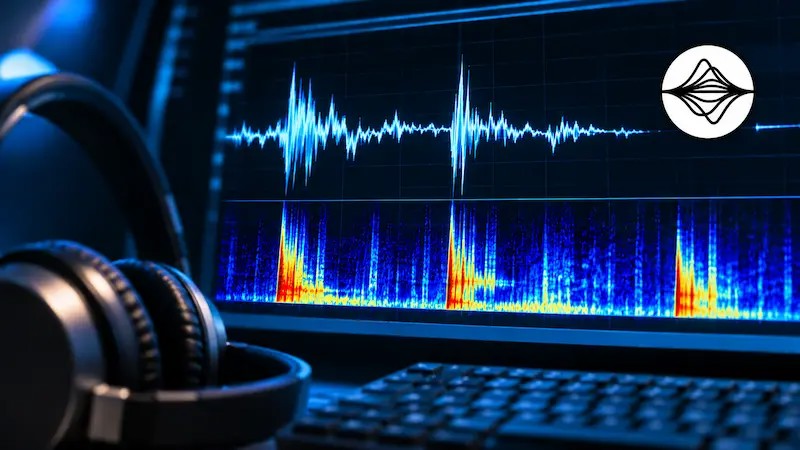
Gunshot audio analysis can help assess how many shots are distinguishable in a recording, their timing and, when the available recordings and scene information permit, their source location. It does not automatically establish the firearm, caliber or identity of the shooter. Each conclusion depends on the acoustic information the recording preserves.[1][12]
A surveillance camera or phone may capture gunfire without showing where it came from. The resulting file can be useful, but the questions must remain separate: counting audible events, reconstructing a firing sequence and comparing possible sources do not require exactly the same evidence. This article examines those questions through published gunshot-acoustics research and documented analysis tools, rather than presenting a new case or an automated identification method.[12]
Why one gunshot can produce several recorded arrivals
A shot is not necessarily represented by a single peak. The rapid release of gases from the muzzle produces the muzzle blast. A supersonic projectile can also produce a separate ballistic shock wave. Whether that wave reaches a microphone depends on the geometry between the projectile’s path and the recording position; it is not present in every recording.[2]
Reflections from the ground, walls and other surfaces can produce further arrivals. Consequently, two nearby peaks may represent two shots, different components of one shot, or a direct sound followed by a reflection. The task is to distinguish the events and their acoustic paths, not simply count the marks on a waveform.[3]
A count of waveform peaks is not, by itself, a count of shots.
How many gunshots can a recording establish?
Counting requires separating candidate shots from echoes, unrelated sounds and overlapping components. Comparing recordings of the same incident may help, but the devices cannot be assumed to preserve identical information. Position, sensitivity and signal processing can produce different representations of the same events.[10]
In a case study published in 2023, Robert C. Maher compared nearby surveillance recordings with more distant gunshot-detection recordings. In that material, the distant recordings did not represent all the shots as completely as the nearby recording. This was a case-specific result, not proof that the nearest microphone is always the most reliable or that automated detection always fails.[14]
The conclusion should distinguish shots supported by the available recordings from the total number of shots in the incident. The latter may remain unresolved if relevant intervals or events were not captured adequately.
Can the recording establish which shot was fired first?
A microphone records a sound’s arrival time, not its emission time at the firearm. When sources are in different positions, different travel times can affect the order in which their sounds reach a recording device. A timeline of peaks must therefore not be treated automatically as a timeline of trigger events.[12]
Multiple recordings introduce another problem: independent devices may start at different moments and may not share a reliable time reference. Aligning one prominent event does not, on its own, establish that the recordings remain aligned throughout. Timing comparisons require an appropriate alignment method and an assessment of its uncertainty.[9]
A defensible reconstruction states whether it describes the order of arrivals in a file or the inferred order of shots at their sources, and what information supports the distinction.
Can a firearm be identified from recorded sound?
A gunshot should not be treated as an invariant acoustic fingerprint. In controlled experiments presented in 2019, Maher found differences between repeated shots from the same firearm. A change in the recorded sound therefore cannot automatically be attributed to a change of weapon.[4]
Research from the Advancing Audio Forensics of Gunshot Acoustics project also documents variation between shots and observation directions. A comparison must account for those differences rather than assume that each firearm or caliber has a fixed signature that survives every environment and recording system.[5]
This does not make comparison meaningless. It limits what a resemblance or difference can establish without suitable reference material and an assessment of the recording conditions. A similar-looking spectrum is an observation to evaluate, not a stand-alone identification.[4][5]
Can gunshot recordings locate the source?
Under suitable conditions, differences in arrival time at several microphones can contribute to a source-position estimate. This is acoustic multilateration. It requires sufficiently reliable microphone positions and time references, as well as correct identification of the corresponding arrivals. Maher and Hoerr describe how geometric uncertainty, noise and reflections can affect the result. A location estimate must retain those limitations rather than be presented as an exact point recoverable from any video.[8]
Loudness alone is not a reliable distance measurement. Maher’s measurements of muzzle-blast directionality show that the sound level changes with the firearm’s orientation relative to the microphone. A stronger recorded impulse need not mean a closer source. Orientation, propagation and recording-system behavior must also be considered.[7]
Why the recording device changes gunshot evidence
A device that records speech clearly may not preserve an intense, short impulse faithfully. In experiments with digital voice recorders, Maher and Shaw documented how overload, coding and automatic gain behavior can affect recorded gunshots. The relevant question is what the actual recording chain retained, not whether the file sounds clear in ordinary playback.[6]
A nearby recording may preserve useful detail but overload. A more distant recording may avoid that problem while being more affected by the acoustic environment. Neither is automatically better for every question.[6][7]
This section concerns the consequences for shot counting and comparison. The broader mechanisms of clipping, coding and processing are explained separately in Audio Artifacts in Forensic Recordings.
What quieter sounds may reveal
The loudest impulse is not necessarily the only informative event. In an experiment published in 2024, Maher compared three simultaneous recordings. A spent cartridge case striking the ground was clearly detectable in one recording but not to the same extent in the others. He associated this difference with the recorders’ automatic gain-control behavior after the shot.[11]
The example shows why a detail missing from one file is not proof that the event did not happen. It does not provide a universal rule for identifying a firearm from the sound of a cartridge case. Quiet mechanical or secondary sounds must be interpreted in the context of the particular recording.[11]
Diamond Cut tools for examining gunshot recordings
Diamond Cut Forensics explicitly includes Gunshot Ballistic Timing in the DCForensics10.8x manual’s tool-selection table. The manual associates this task with markers, the time display and the Spectrum Analyzer, supporting the examination of event positions and intervals in a recording.[15]
The same table lists Gunshot Ballistic Identification Matching, associated with the time display and spectrogram for examining and comparing recorded impulses.[15]
These are documented gunshot-analysis applications, not evidence of an automatic, validated identification of a specific firearm or caliber. Recorded timing and visual similarity still require the acoustic and contextual assessment described above.[4][5]
| Documented function | Role in examining a gunshot recording |
|---|---|
| Waveform, markers and time display | Mark candidate events and measure their positions and intervals in the file. These remain recorded arrival times, not automatically firing times.[15][17] |
| Spectrogram | Examine the time-frequency structure of selected impulses and their surrounding sound. The display supports description and comparison, not source attribution by shape alone.[16] |
| Spectrum Analyzer | Compare frequency content. The version 11 manual also documents saving and recalling spectral traces for comparison with reference data.[17] |
For general display interpretation, see the separate guide to reading a spectrogram.
DC Forensics 11 also includes Sound Search, described by the manufacturer as a way to find similar sounds within a file. It can help select candidate passages for review; a match is not a validated shot count or proof of a common firearm. This feature is specific to the documented version 11 functionality and should not be assumed to exist in version 10.[18]
Impulse-removal filters serve a different purpose from impulse examination. Because they are designed to remove impulsive disturbances, applying them indiscriminately could alter the events being investigated. Keep an untreated reference and document any processed derivative.[16][13]
This is a summary of manufacturer documentation, not an experimental validation of the software on gunshot recordings. It does not imply that Diamond Cut was used in the research cited elsewhere in this article.
What to retain for a gunshot recording assessment
Preserve the original recording, or the earliest available generation, rather than replacing it with a trimmed, converted or processed excerpt. Keep any other recordings of the incident and the available information about where the devices were positioned. These materials can affect both the timing analysis and the interpretation of what each microphone captured.[13][9]
Evidence handling and working-copy procedures are covered on the Forensic Audio Methodology page. To describe the available recordings and the specific question requiring assessment, use the Contact page.
The important distinction is between what a recording contains and what it establishes. A supported shot count or timing observation does not, by itself, resolve firearm identity, exact location or responsibility.[12]
Scope: this article discusses published research, documented tools and the interpretation of gunshot recordings. It does not present an experiment or gunshot case conducted by this website, a guarantee of an identifiable result, or a legal opinion.
Sources and references
[1] National Institute of Justice (2023). The Emerging Field of Firearms Audio Forensics.
[2] Robert C. Maher (2007). Acoustical Characterization of Gunshots.
[3] Robert C. Maher; Steven R. Shaw (2008). Deciphering Gunshot Recordings.
[4] Robert C. Maher (2019). Shot-to-shot variation in gunshot acoustics experiments.
[5] Robert C. Maher (2017). Advancing Audio Forensics of Gunshot Acoustics.
[6] Robert C. Maher; Steven R. Shaw (2014). Gunshot Recordings from Digital Voice Recorders.
[7] Robert C. Maher (2025). Measured directionality of firearm muzzle blast sounds for audio forensic analysis.
[8] Robert C. Maher; Ethan R. Hoerr (2018). Audio Forensic Gunshot Analysis and Multilateration.
[9] Benjamin F. Miller; Fraser A. Robertson; Robert C. Maher (2021). Forensic Handling of User Generated Audio Recordings.
[10] Robert C. Maher; Ethan R. Hoerr (2019). Forensic Comparison of Simultaneous Recordings of Gunshots at a Crime Scene.
[11] Robert C. Maher (2024). Examining tell-tale sounds in forensic gunshot recordings.
[12] Durand R. Begault; Steven D. Beck; Robert C. Maher (2019). Overview of Forensic Audio Gunshot Analysis Techniques.
[13] Scientific Working Group on Digital Evidence (SWGDE) (2022). Best Practices for Forensic Audio.
[14] Robert C. Maher (2023). Close and Distant Gunshot Recordings for Audio Forensic Analysis.
[15] Diamond Cut Productions, Inc. DCForensics10.8x Audio Laboratory User’s Manual, 25th Edition, tool-selection table, p. 83. See also Application Note AN-23, p. 28.
[16] Diamond Cut Productions, Inc. DCForensics 10 Detailed Feature set.
[17] Diamond Cut Productions, Inc. DCForensics11.0x Audio Laboratory User’s Manual, 26th Edition.
[18] Diamond Cut Productions, Inc. Diamond Cut Forensics 11.0 Audio Laboratory: product details and version history.
The sources include experimental studies, conference contributions, an institutional overview, professional guidance and software manufacturer documentation. They are not all standards or papers whose full manuscripts underwent peer review. The SWGDE reference is version 2.5, dated June 9, 2022. Citation does not imply affiliation or accreditation.